


10,000+
active communitiesBack
Community tech · Knowledge management · Telegram
How Chatlogix turns busy Telegram communities into knowledge bases
An active Telegram community produces 300 to 500 messages a day, and most of the value sinks out of reach within hours. We built the AI infrastructure behind the Telegram agent Chatlogix — a spam gate, a daily digest that makes a full day readable in two minutes, and a searchable knowledge base. The system processes hundreds of thousands of messages a day across 10,000+ communities.
Active communities
10,000+
Users reached daily
~800K
Digests published per day
~10,000
The Problem
Where the old process broke
Telegram is where professional communities live, and almost none of the value they create survives past a few hours. A community of a few hundred to a few thousand members generates 300 to 500 messages a day. A member opens Telegram, scrolls the last twenty messages, and assumes they caught up — but the useful thread about a tool, or the decision that was reached, sits buried beyond Telegram's search. New members ask the same five questions every week, because the answers already in the history stay out of reach. Admins watch engagement drop as members mute the chat or leave. On top of that, an open community fights 10 to 15 spammer bots a day pushing VPN offers and crypto schemes — and that noise leaks straight into any summary built on top of the feed.
300–500Messages per day in an active community
Same questionsRepeated every week by new members
10–15Spammer bots per day in an open chat
What we built
A digital archivist for Telegram communities
Most tools try to shrink the feed. We built the opposite: a layer that extracts signal and makes it permanent, with a gate that keeps noise out before anything else runs. The system works across three layers — Chat Summary, Super-Summary, and Anti-spam — on top of a knowledge base that compounds.
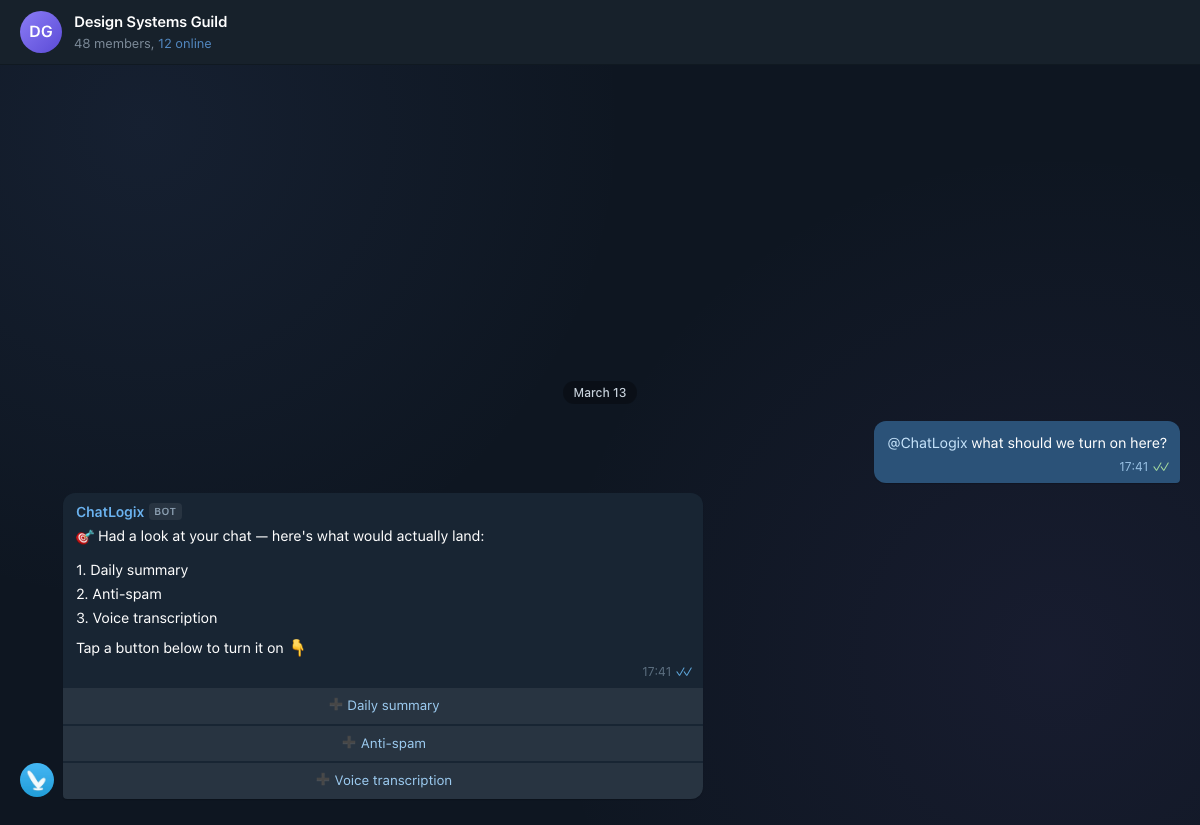
01 · Agent
Chat-aware setup advice
The agent reads the chat before recommending anything, then names the features that fit this group, ranked by relevance rather than listed off a menu. Each recommendation activates in one tap, with no settings screens in between.
agent
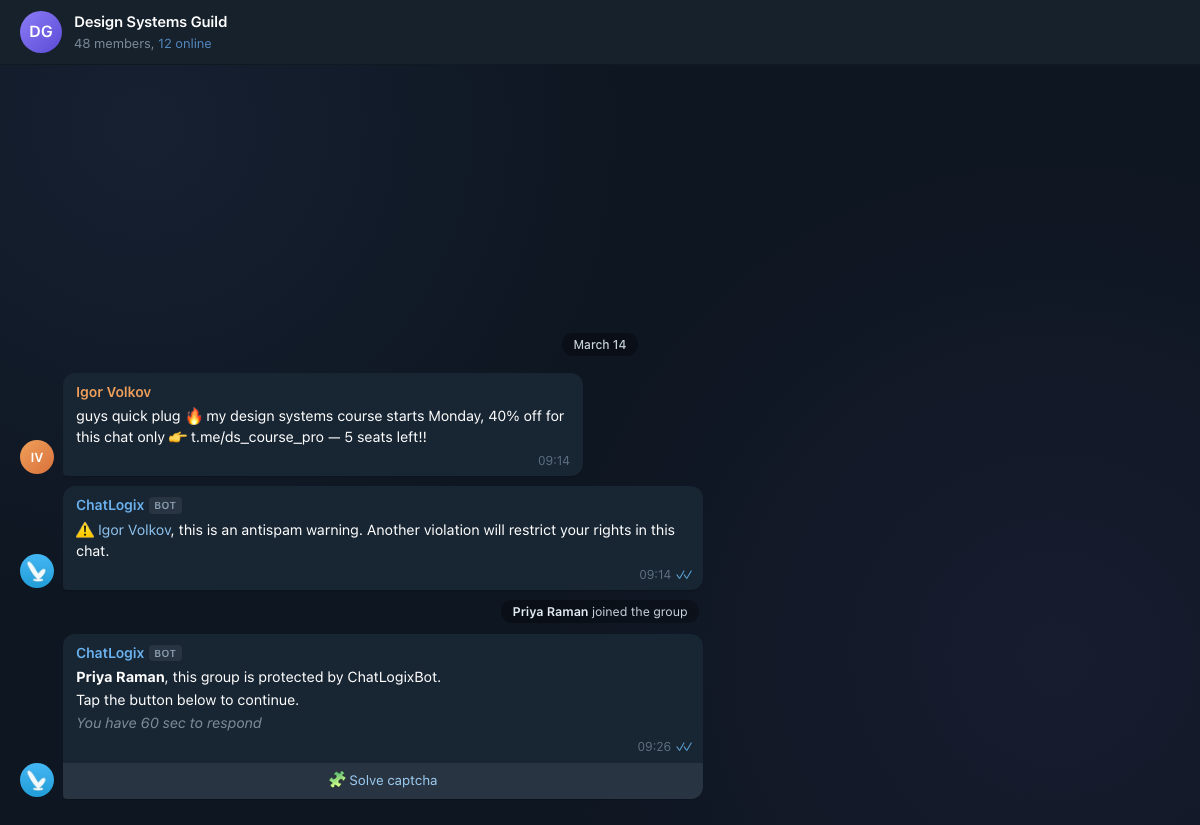
02 · Anti-spam gate
Two-layer spam defence
A captcha stops bots at the door, before the first message lands. A content filter handles the rest, including the ad from a member who joined months ago and passed the captcha long since.
anti-spam gate
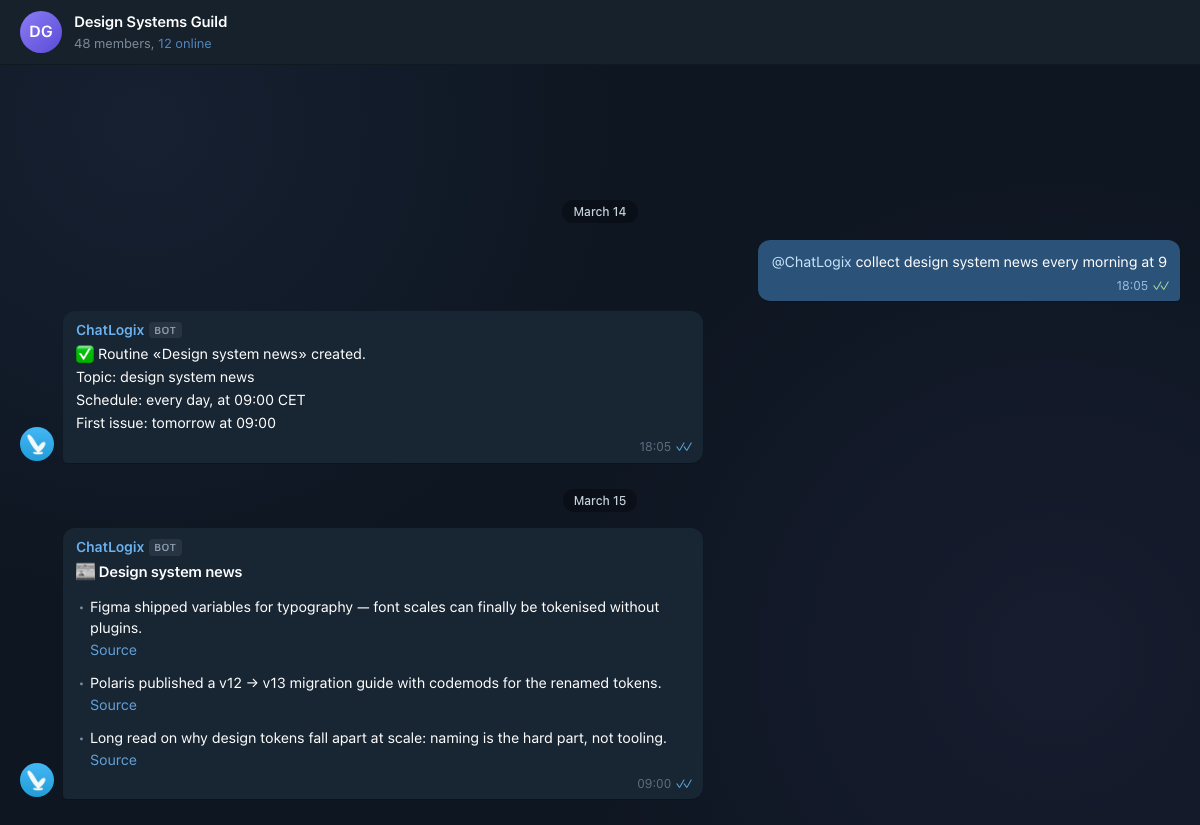
03 · Routines
Recurring digests, set up in one sentence
A single instruction like 'collect design system news every morning at 9' is enough. The system extracts the topic and the schedule from that one sentence, confirms both, and publishes on its own from the next morning. Every item links back to its source.
routines
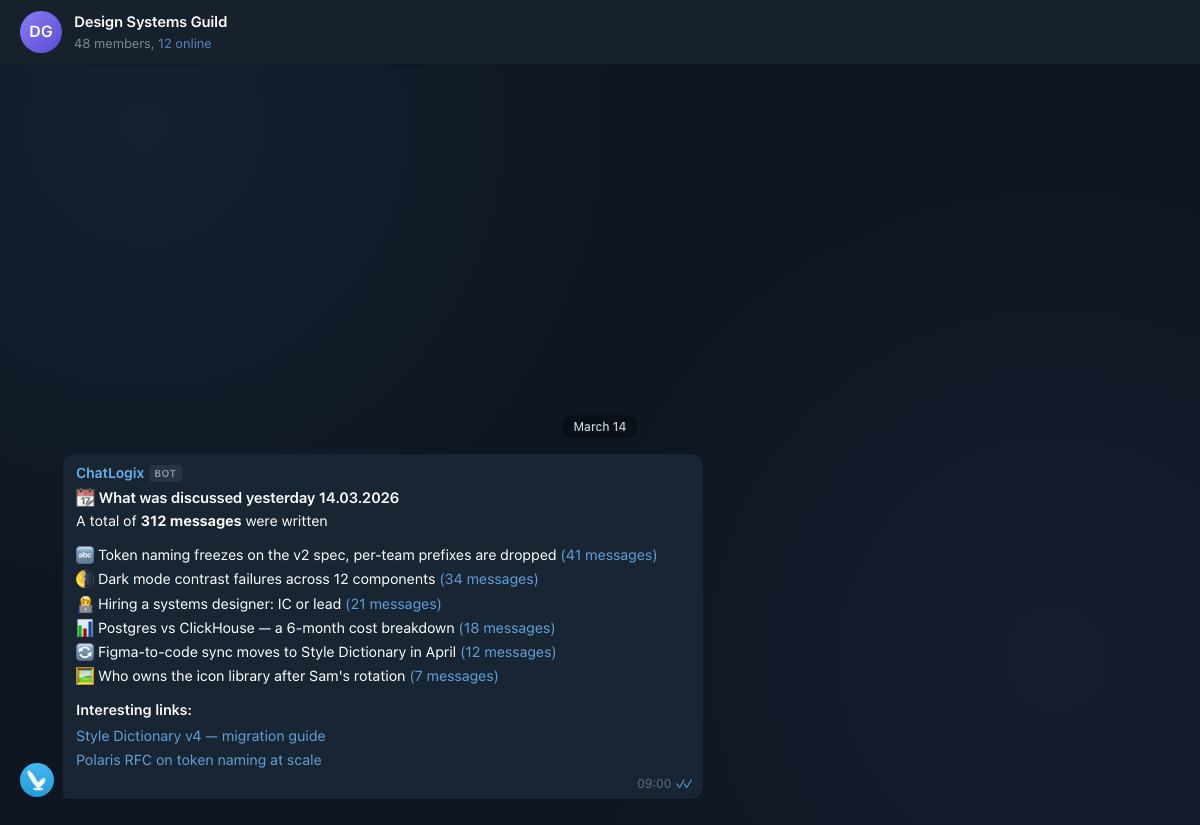
04 · Chat summary
Daily digest in the group
Every morning a bot posts what the previous day was about. Topics are ranked by how much was said, each linking back to the message where it started. A 300-message day reads in two minutes.
chat summary
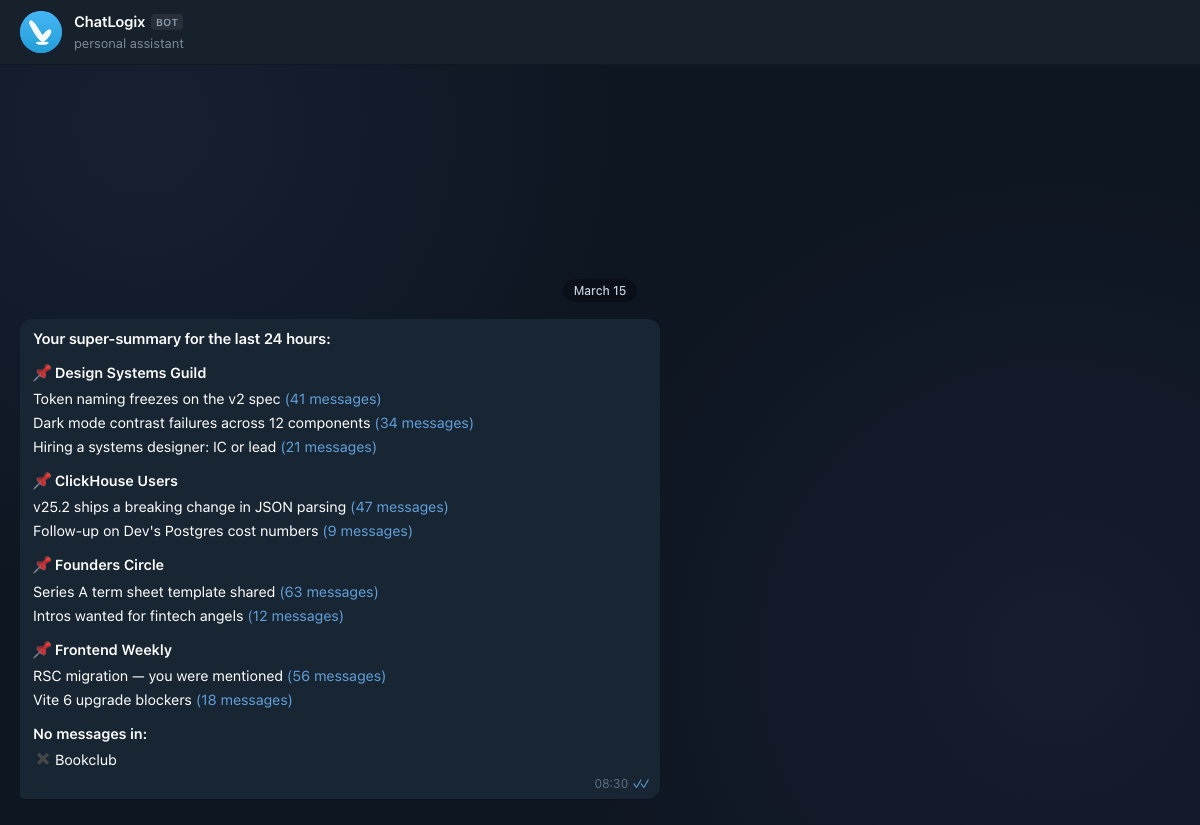
05 · Super-summary
Every chat, one digest, in DMs
A single message covers every chat at once, grouped by chat, topics ranked by volume, each linking straight into the conversation. Five chats and a thousand messages become one read over coffee.
super-summary
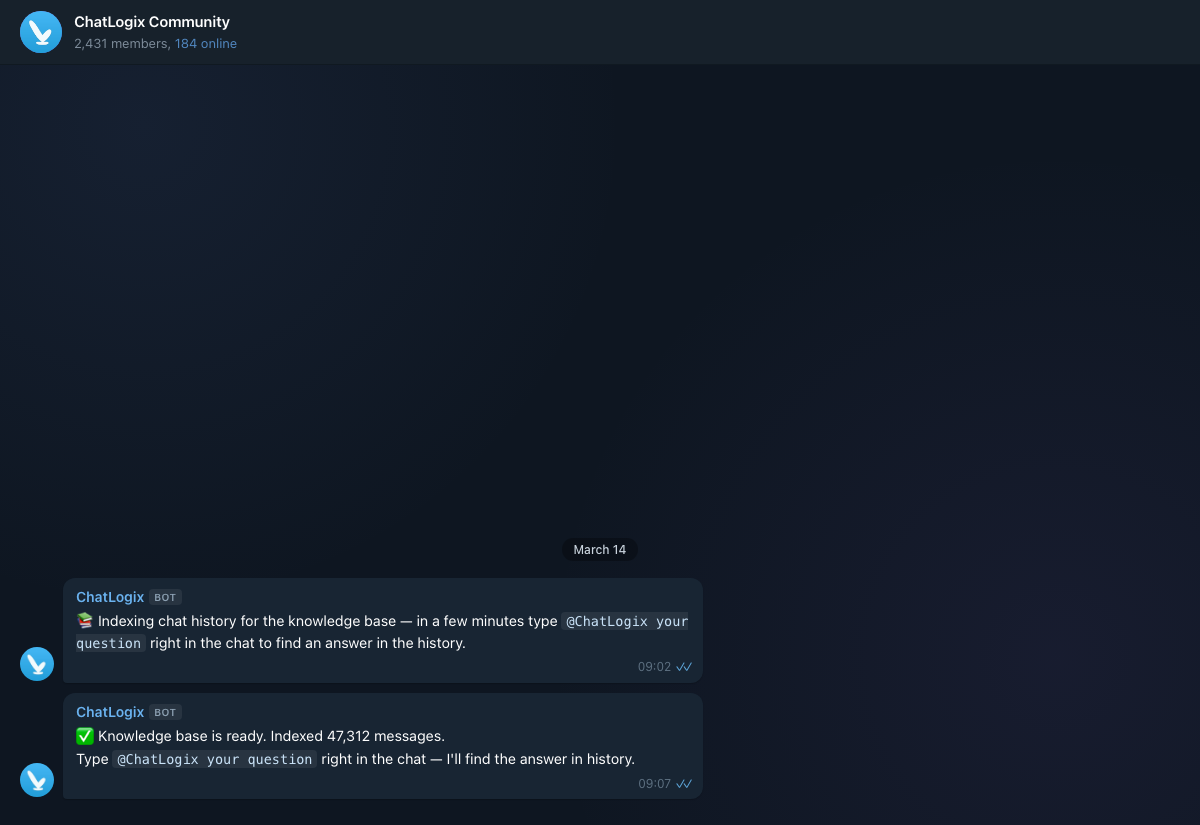
06 · Knowledge base
Self-building knowledge base
The bot indexes the chat's entire history on its own, across tens of thousands of messages, with nothing to file and nothing to curate. From then on, anything ever said in the chat sits one question away.
knowledge base
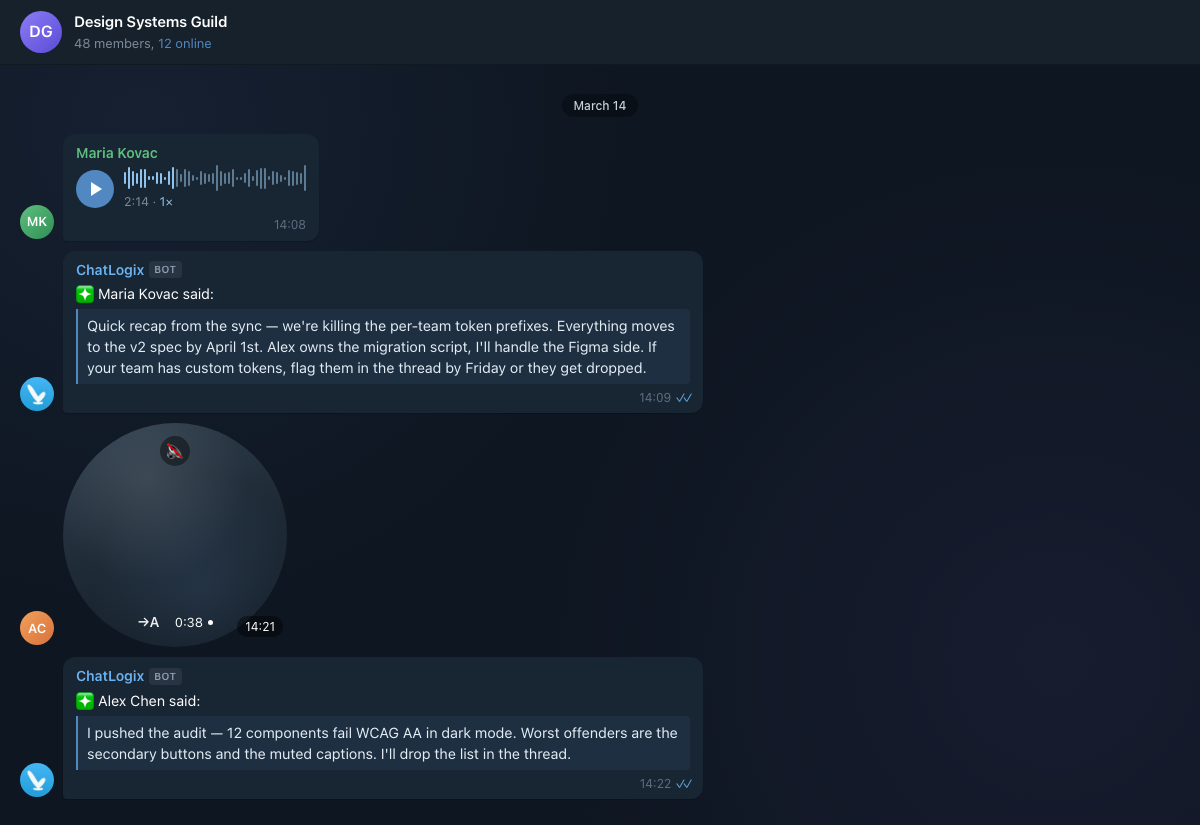
07 · Multimedia capture
Voice and video notes, transcribed
Voice messages and video notes are transcribed automatically, so the half of the chat that lives in audio stops being invisible. Transcripts are searchable and enter the digest like any other message.
multimedia capture
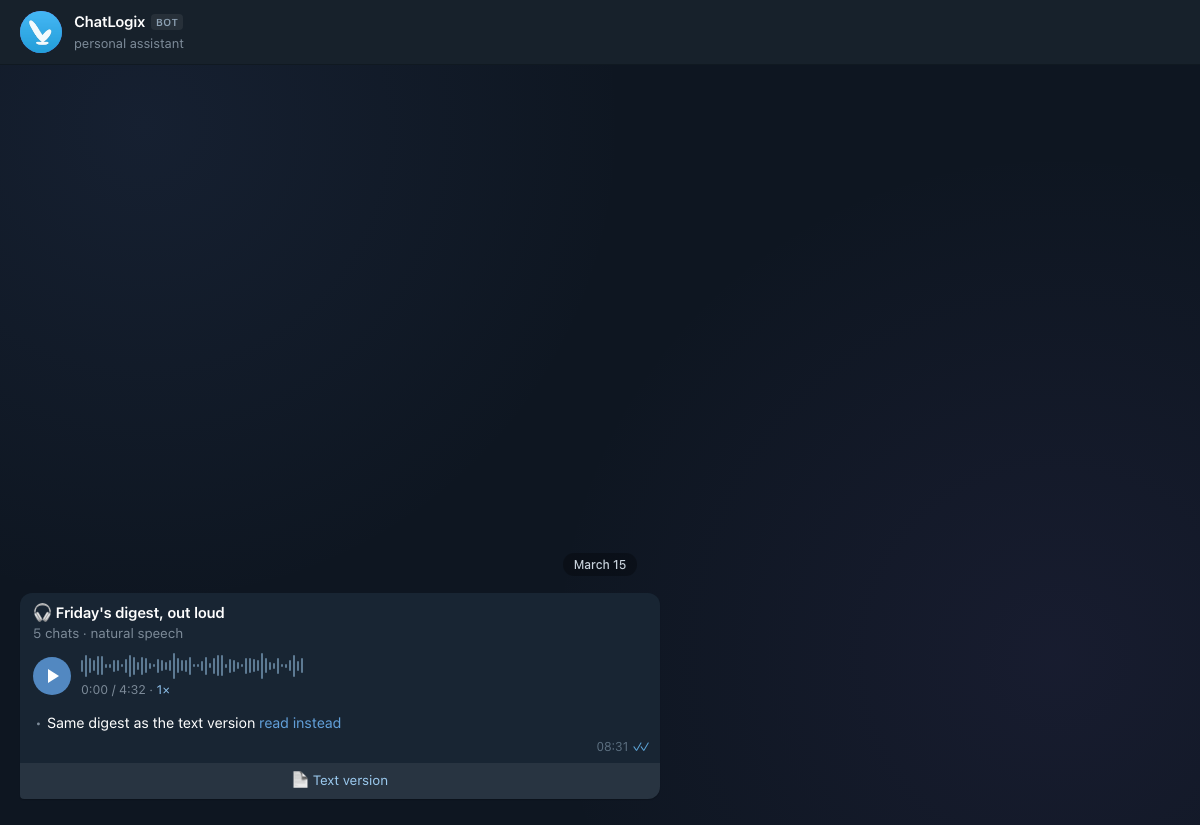
08 · Voiced digests
Text-to-speech digests
The daily summary is also rendered as natural speech, so it can be caught up on away from the screen, while commuting, walking, or between meetings.
voiced digests
09 · Semantic search
Ask in your own words
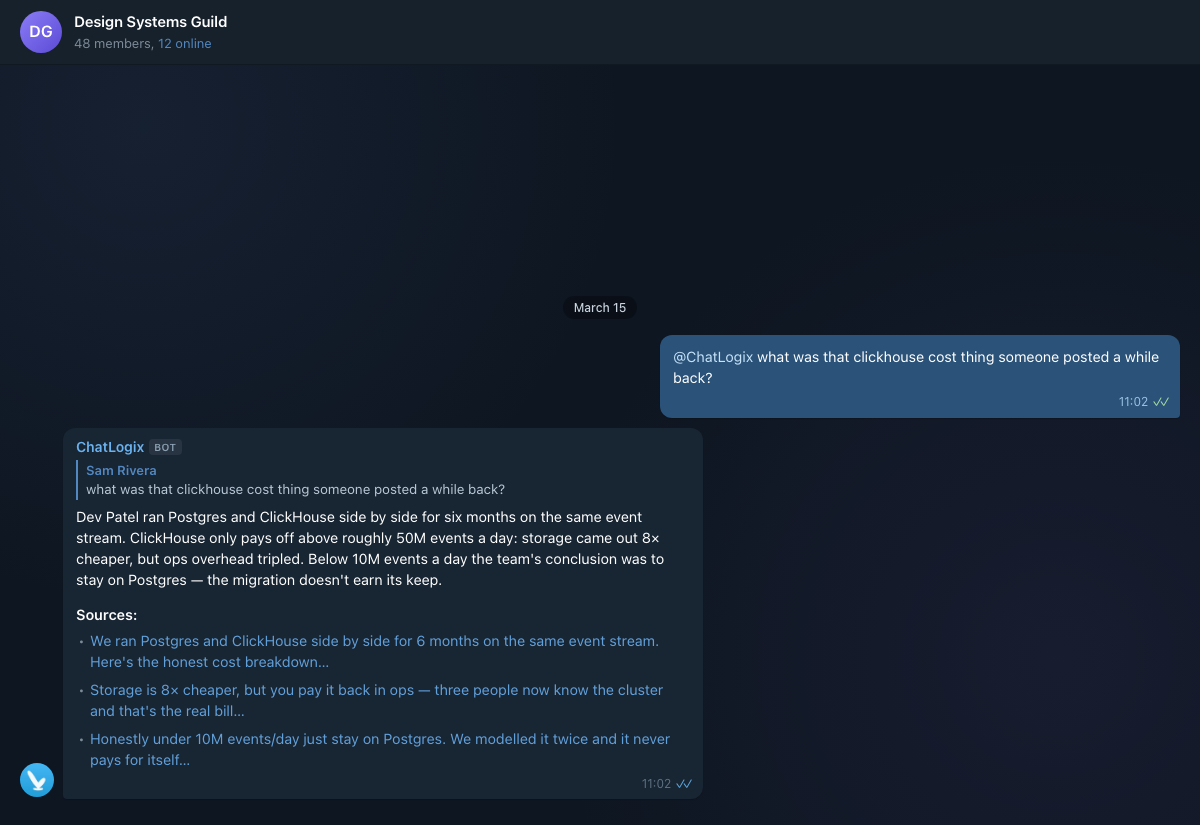
A half-remembered question like 'that clickhouse cost thing someone posted' is enough. The system answers from the chat's history, surfacing the exact quotes it drew on, each linking to the original message. Not one keyword has to match.
semantic search
Results
What changed after launch
Growth ran entirely on word of mouth. Admins install the bot, it solves a real problem, and they bring it into their second and third communities. The daily digest became a daily habit — admins say they would notice the moment it stopped publishing. When a free optional tool quietly becomes infrastructure, the underlying pain was real.

~800K
unique users reached daily
~10,000
digests published per dayThe moat
The archive underneath the summary
Anyone can build a Telegram summarizer. The defensible part sits in what accumulates underneath it, and in what has to run before it — data, architecture, and trusted networks a competitor would need the same years to match.
01
Architectural integration
Anti-spam runs before summarization, built into the pipeline from the start. By the time an external bot deletes a spam message, a bolted-on summarizer has already read it.
02
Compounding knowledge base
Every processed message adds to a community's private archive. A year in, that community owns a searchable record of its own history a new competitor would need the same span of data to match.
03
Admin network effect
Admins who run several communities bring the bot to all of them. The product spreads through the same trusted networks it serves, and growth stays organic.
Project details
An ongoing, co-built product
moat8 built the AI knowledge and moderation infrastructure behind Chatlogix.
Stage 1 · Clean feed & daily digest
Built the message stream pipeline and in-house spam gate that runs ahead of everything else, then expert signal detection and the structured Chat Summary publishing into groups — the first output members felt every day.
Stage 2 · Knowledge base & retrieval
Added the structured knowledge base, voice transcription and document reading, the cross-chat Super-Summary, semantic search, and voiced digests — turning every processed message into a permanent, searchable record.
System components enabled
Anti-spam gateExpert signal detectionChat summarySemantic analysisVoice transcriptionImage & document readingVoiced digestsStructured knowledge baseSemantic search
Tech stack
What it runs on
A production stack, self-hosted end to end in docker-compose, chosen for control, cost, and multilingual reliability.
Text processing
OpenAI 5-miniOpenAI 4o-miniMiniMax v3Mistral Small 2603
Cheap, fast, multilingual, with reliable JSON output. Each task routes to the model that fits it — from summarization to spam classification — instead of forcing one model to cover everything.
Audio processing
ElevenLabs Scribe v2
Accurate transcription with automatic language detection, and it stays cheap in batch.
Text to speech
Gemini 3.1 TTS Flash
Multi-speaker, natural voice, low cost, and one provider shared with text generation.
Q&A search
Perplexity Sonar Pro
A sourced web answer in a single call.
Web search
Perplexity Sonar Pro Search
Deep agentic web search for current information.
Embeddings
OpenAI text-embedding-3-large
Top-tier retrieval, multilingual.
Backend
Node.js · TypeScript · Express 5grammYPrisma · PostgreSQLRedis (ioredis) · BullMQ · Bull BoardQdrantZod · zod-to-openapiLangfuse · OpenTelemetry · Bugsnagnode-cron · date-fns-tz
One language runs across backend and frontend, with a shared type contract through OpenAPI. grammY runs the bot as a typed, modern Telegram framework — the core of the product. Express 5 serves the Mini App REST API, hardened with Helmet, CORS, rate limiting, and basic auth. Redis and BullMQ handle background queues; Qdrant is the self-hosted vector database behind RAG and semantic search. Langfuse and OpenTelemetry trace every LLM call, and node-cron with date-fns-tz schedule digests by timezone.
Frontend
React 19 · TypeScript · ViteSCSS · Mantine UI · HugeIconsEffector · patronumReact Hook Form · React Router 7axios · i18next · date-fnsopenapi-typescriptPostHog
React 19 and TypeScript are the standard for a Telegram Mini App, and strict typing keeps large forms and state stable. Vite gives instant HMR and fast production builds. Mantine provides a ready design system for forms, dates, and notifications. Effector with patronum keeps state predictable, testable, and light on re-renders; React Hook Form keeps forms fast with minimal re-renders.
Next step