

600→2,000
placements per monthBack
Influencer marketing · AI pipeline
Scaling from 600 to 2,000 influencer placements with AI
The agency runs influencer marketing campaigns across Latin America, Southeast Asia, and Africa. Their outreach process maxed out at 600 placements a month and converted 1% of contacts. We built an AI system that automates the full pipeline, from finding a creator across the open web to driving a conversation toward a clear goal — scaling placements 3.3× and doubling conversion rate.
Monthly placements
600→2,000
Contact-to-placement conversion
1%→2%
Median influencer reply time
48h→24h
The Problem
Where the old process broke
The agency connects brands with YouTube, Instagram, TikTok and other social media creators across Latin America, Southeast Asia, and Africa. The business runs on volume: find the right creator, get them on a call, verify their numbers, and close the slot hundreds of times a month. In practice, this meant searching by hand across platforms, chasing contacts one by one, unreliable profile data, constant fraud attempts in analytics screenshots, and operators struggling to handle objections. The process was entirely dependent on operator hours — there was no version of it that scaled without proportionally growing the team. They also relied on multiple separate third-party tools just to find roughly matching bloggers, collect their publicly available statistics, and filter by reach and topic.
600Placements per month
1%Contact-to-placement conversion
ManualHand-searched, one contact at a time, across scattered third-party tools.
What we built
A multi-stage AI pipeline
We built a multi-stage AI system that handles every repetitive step in the outreach pipeline, from finding relevant creators across the open web to running conversations toward a goal — with a live operator dashboard for supervision, edits, and exceptions.
01 · Creator search
System-driven creator search
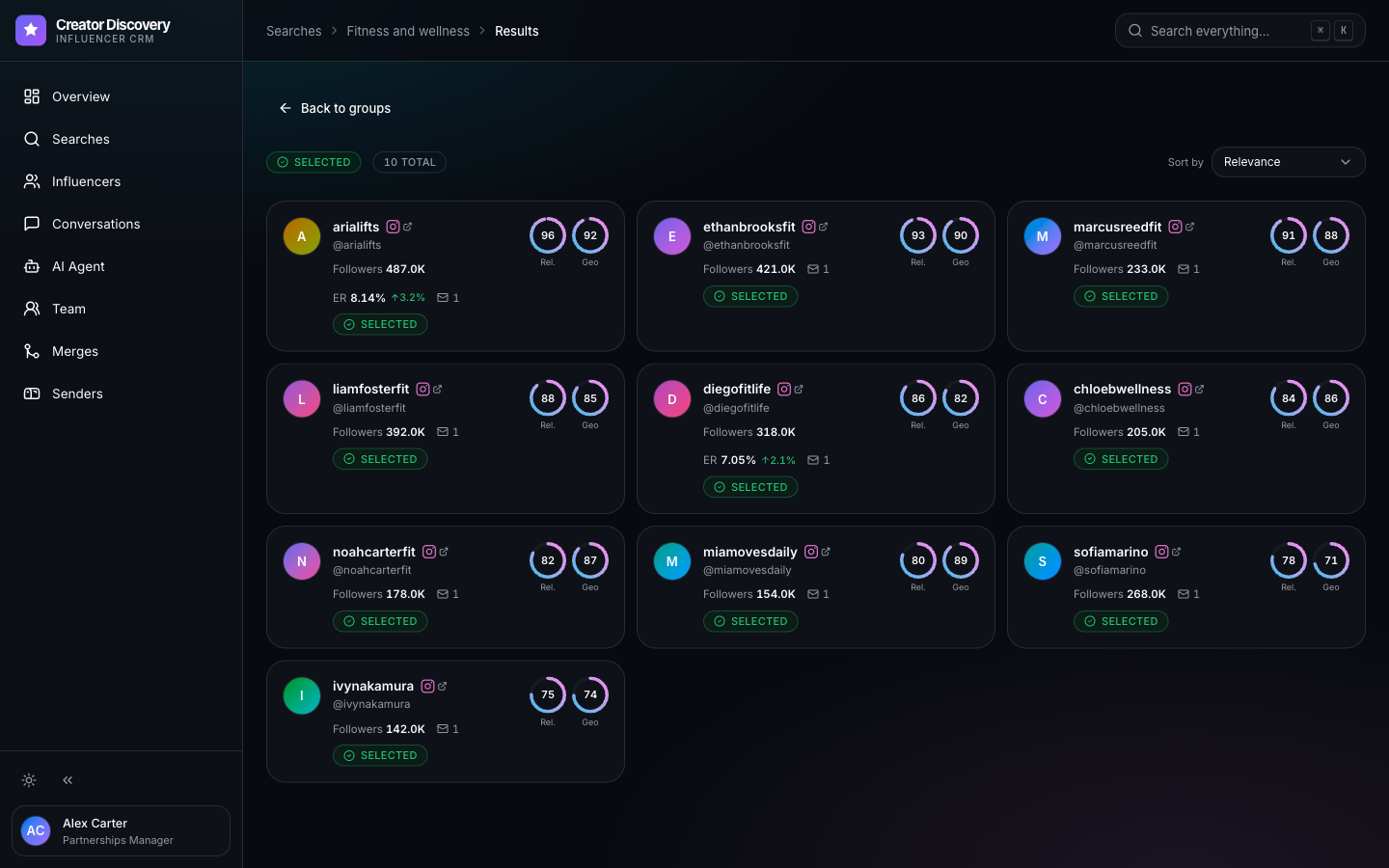
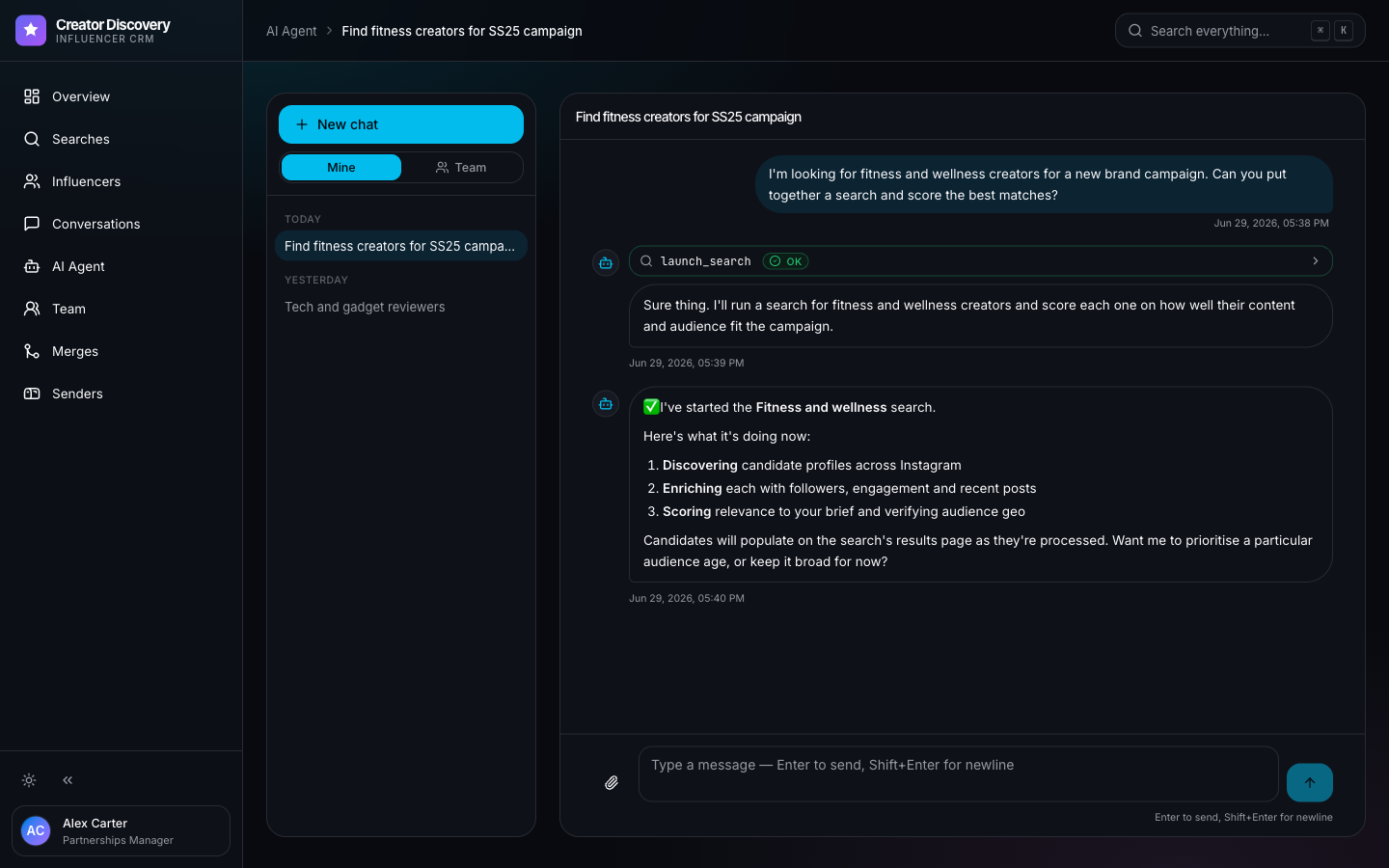
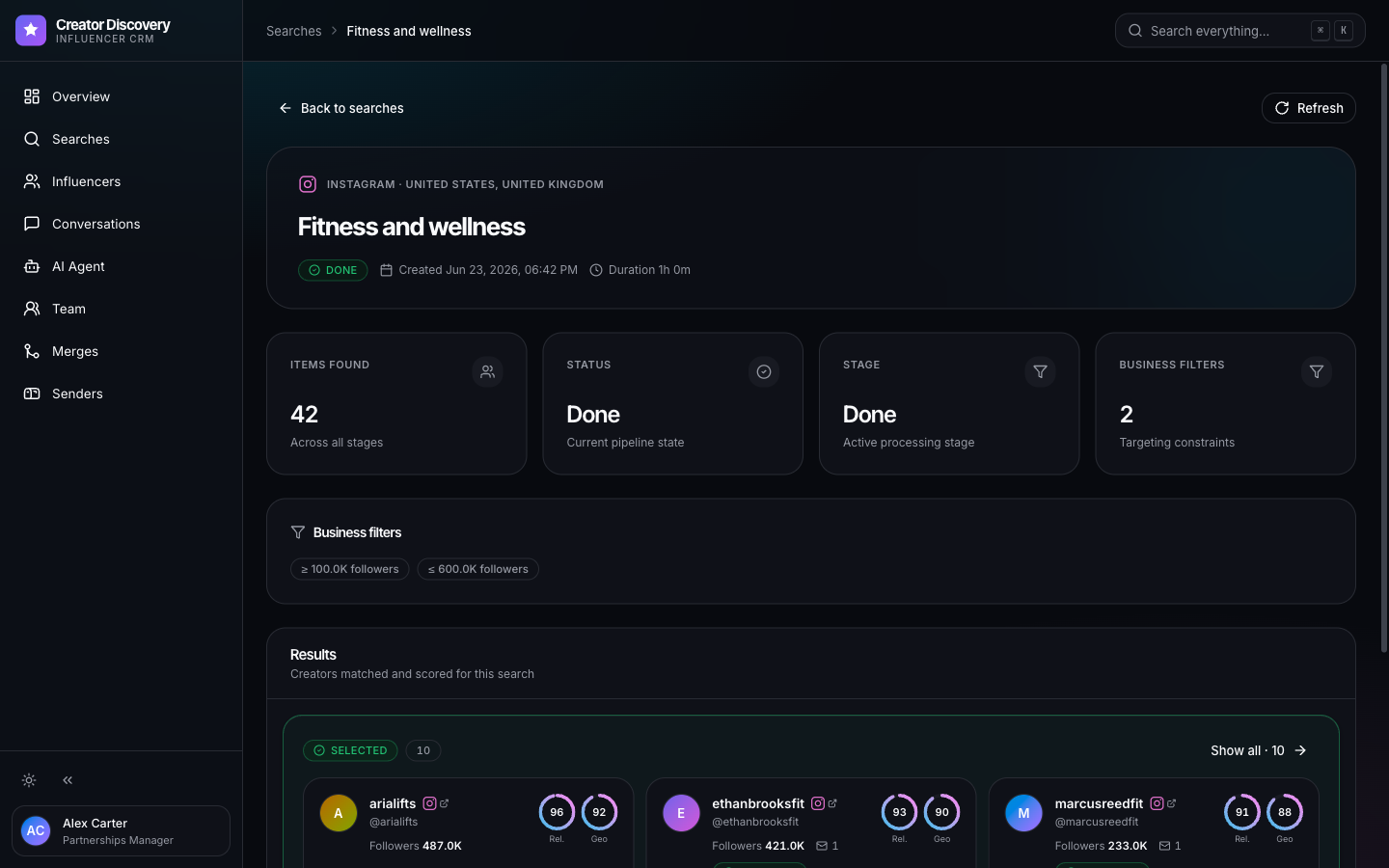
The system searches creators across the open web by niche, geography, audience parameters, engagement ratios, and posting frequency, with configurable thresholds by category. A manager can launch a search directly in the interface or through a chat agent: describe the campaign, refine the brief together with the agent, and let it run the search with the right filters.
creator search
02 · Contact capture
Automatic contact unification
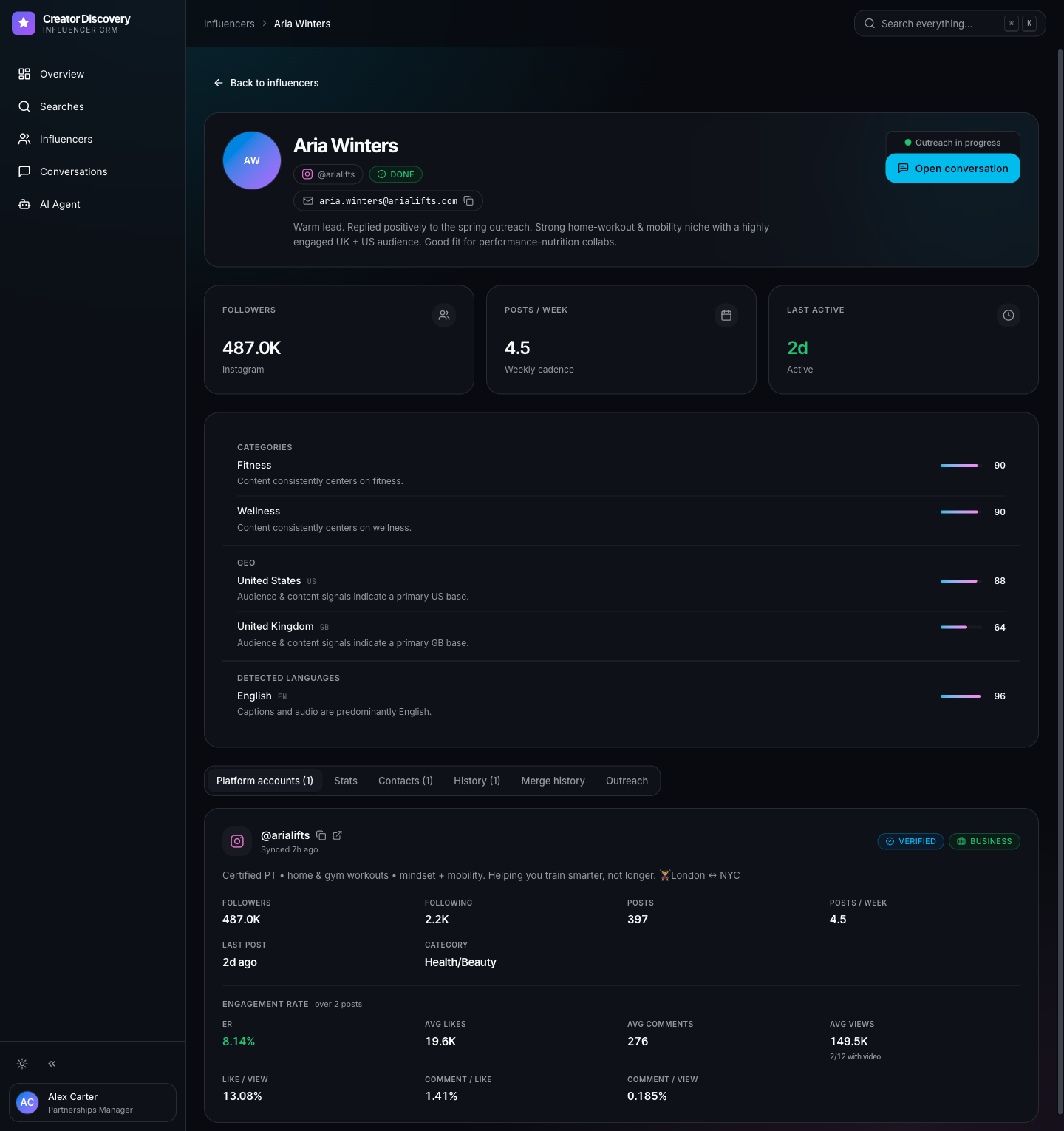
For each qualifying creator, the system extracts contact information from bios, link-in-bio pages, and connected profiles, then cross-references them across multiple platforms to build a single unified record. Accounts that previously promoted competing brands are filtered out automatically. Managers see a ready-to-use card with contacts and basic context before anything goes into the CRM.
creator record
03 · Geo inference
Algorithmic geography detection
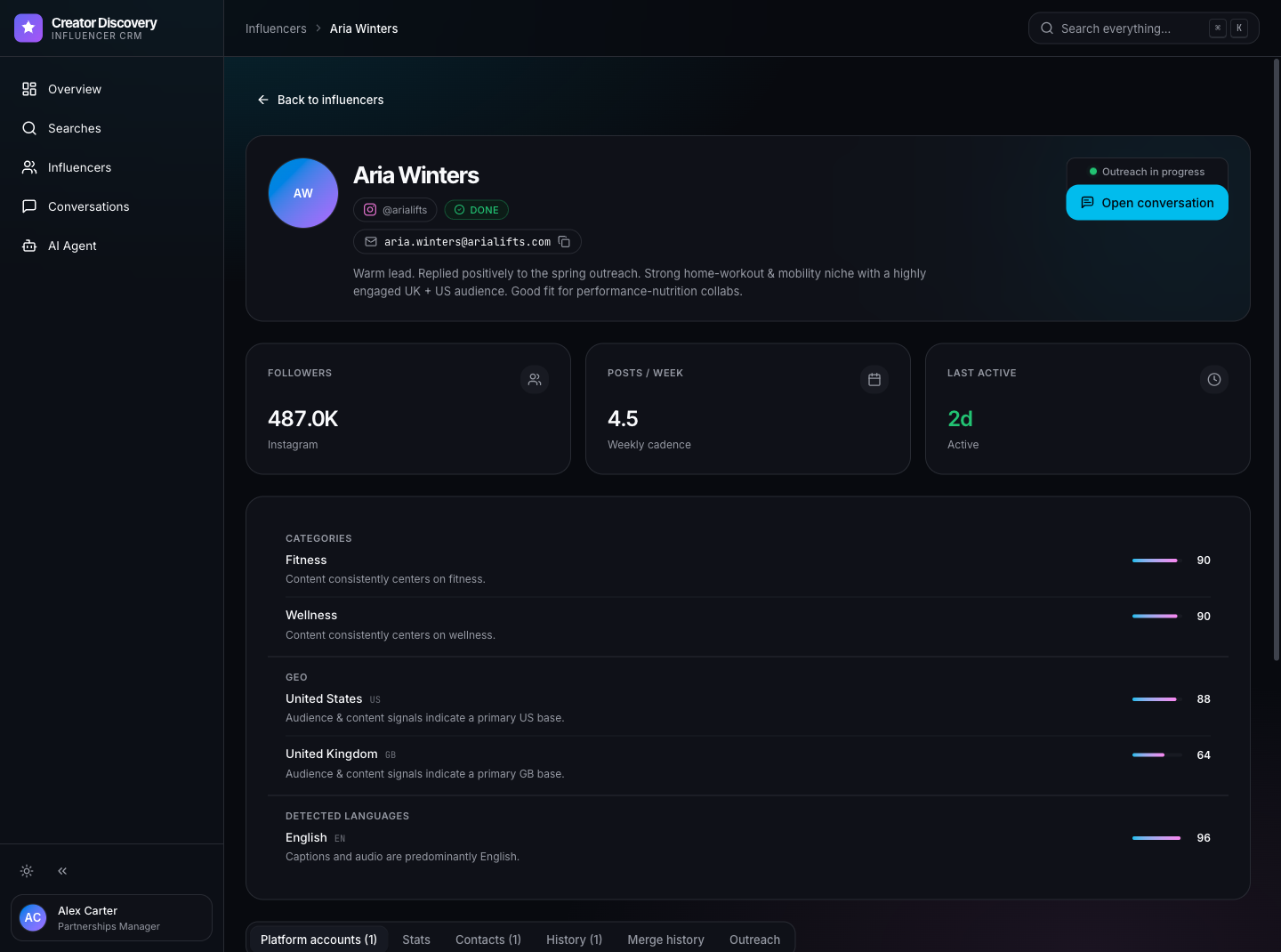
The system determines audience geography from content language and topic signals, not the country listed on the profile. This is especially important because bloggers frequently post content targeting a different country or language than their listed location.
audience geography
04 · First-touch outreach
Automated first-touch and parsing
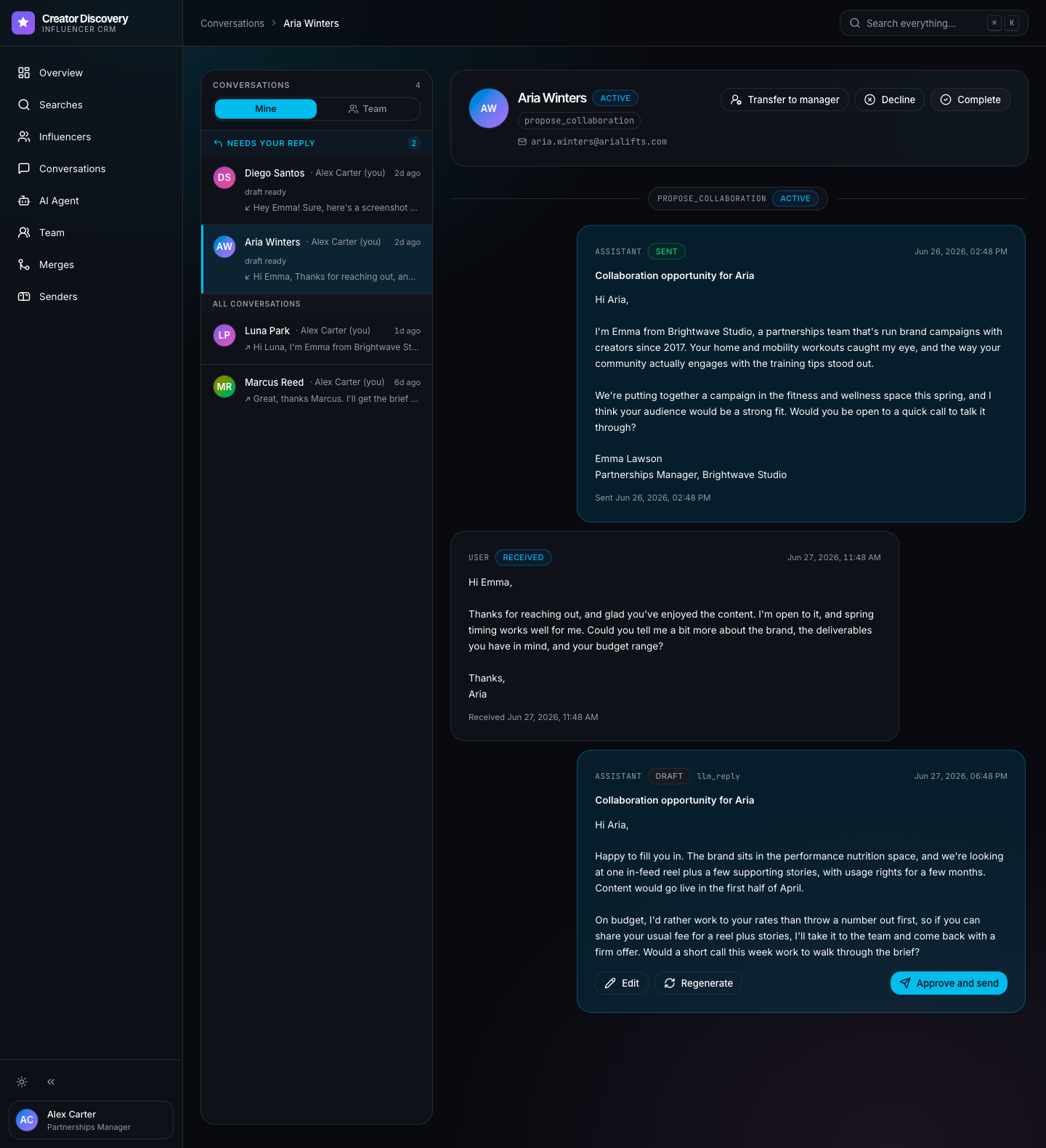
A personalized first-touch email goes out in the creator's language, usually with a clear goal such as requesting the channel's audience stats or moving the conversation to the next step. Replies are parsed automatically, and once the requested detail is present, it's captured without asking again. The operator can review and adjust messages at any point.
first-touch email
05 · Manager assistant
AI copilot for managers
The agent lives inside the platform and managers can ask it to launch a search or check influencers' stats from a screencast or screenshots. A built-in writing skill helps draft outreach copy and handle objections on the spot.
manager assistant
06 · Stats verification
AI vision-based fraud checks
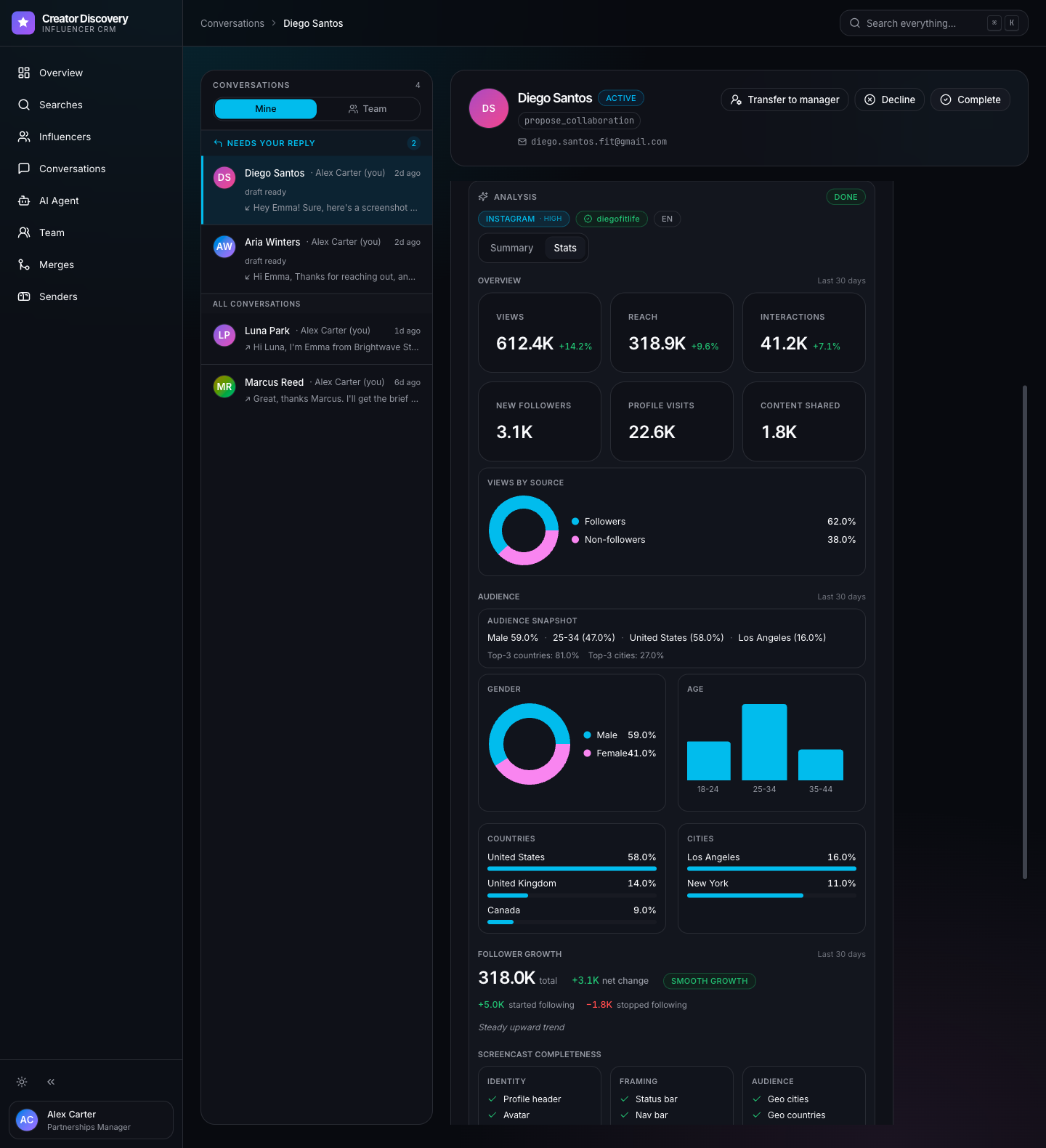
When screenshots or screen recordings arrive, a vision model processes them frame by frame: checks that the account matches, extracts all required metrics, flags missing data or outdated time windows, and highlights possible signs of manipulation. It also detects attempts to hide information — such as spliced videos, cropped screenshots, or mismatched accounts. If something is off, the system automatically asks the creator for additional proof instead of relying on an operator to notice it.
analytics verification
07 · Operator dashboard
Operator-supervised semi-automation
Operators see a live feed of every conversation with the AI's suggested next message. They can send, edit, or skip with one click, keeping control over tone and edge cases. The system currently runs in semi-automatic mode in live campaigns and is designed to move toward higher levels of automation as confidence grows.
operator dashboard
08 · CRM memory
Reusable creator CRM
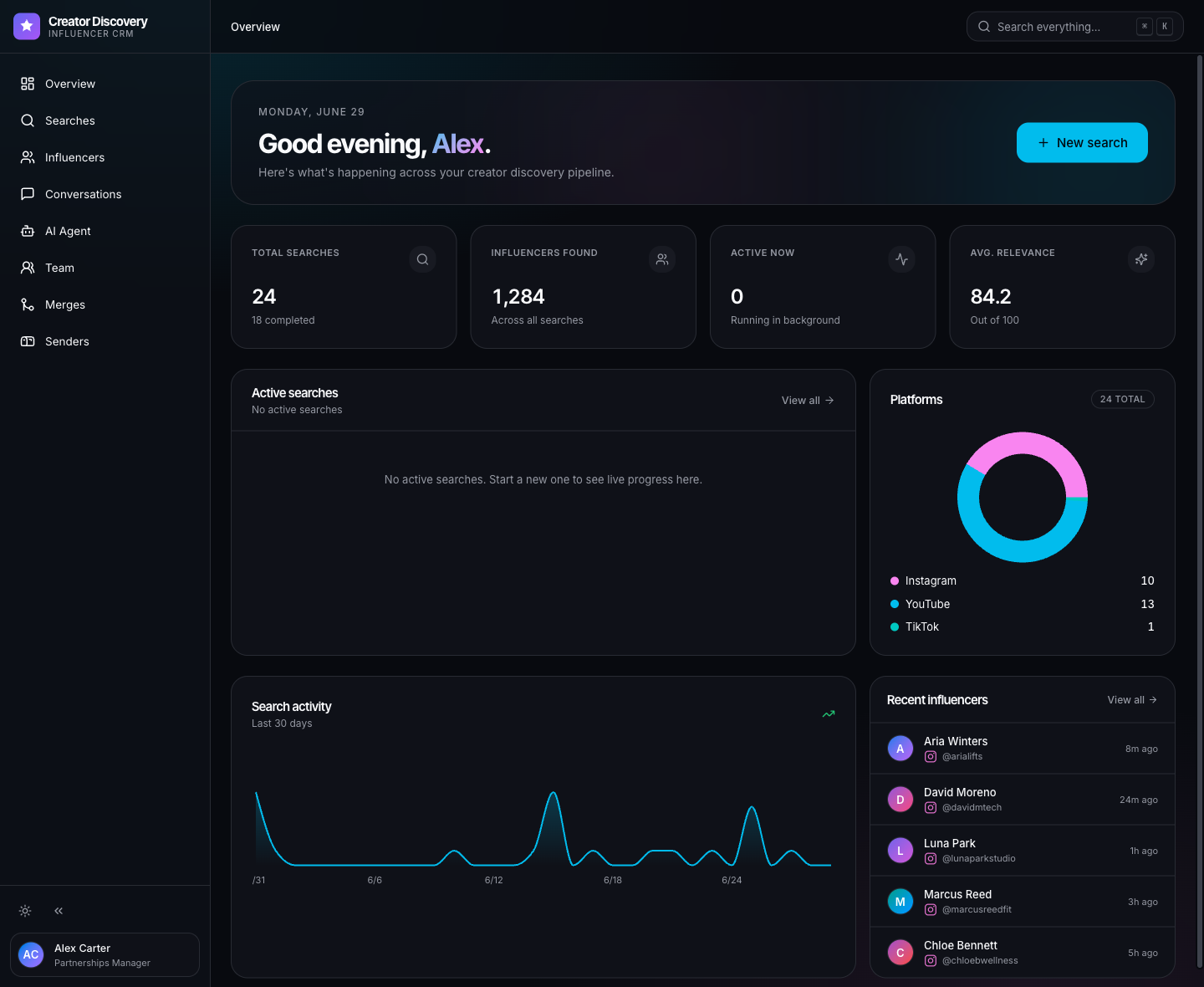
All found and contacted creators are stored in the internal CRM, so managers can re-use existing contacts across campaigns instead of starting outreach from scratch. Every interaction, captured detail, and verification result stays attached to the creator's record, turning each campaign into compounding contact data the agency owns.
creator crm
Results
The numbers after the breakthrough

1%→2%
contact-to-placement conversion
48h→24h
median influencer reply time
manual→AI
fraud detectionThe moat
Hard to replicate, sharper over time
The agency operates in markets where fraud patterns, engagement norms, and outreach etiquette differ by region. The system encodes that local knowledge and learns from the agency's own best conversations — so as placement volume grows, the moat deepens.
01
Category-specific thresholds
Engagement and quality bars are tuned per niche and geography, not applied as one global filter.
02
Geo inference for messy data
Audience location is derived from language and topic signals, tuned for markets where profile data is routinely wrong.
03
Fraud detection on real cases
Trained on real analytics manipulation cases the agency has already encountered — a feedback loop that compounds with every campaign.
Project details
Two-month paid pilot
Two developers and a project manager. You pay for the win, not the headcount.
Month 1 · Foundations
Delivered working parsers and data enrichment: YouTube and Instagram parsers with configurable criteria by niche, geography, and engagement thresholds; contact extraction and cross-platform profile mapping; the geo intelligence engine.
Month 2 · Automation live
Added outreach automation, the manager assistant, stats verification, and the operator dashboard for semi-automatic review.
System components enabled
Custom crawlersCross-platform profile mappingGeo inference engineGoal-based email outreachEmail automation · UnipileVision LLM stats verificationOperator dashboard · semi-autoChat-based search agentConversation assistant mode
Tech stack
What it runs on
A production stack chosen for cost, reliability, and ownership — every layer the agency keeps on delivery.
Backend
Python · FastAPISQLAlchemy 2.0 · asyncpg · AlembicCelery · RedisSeaweedFS
Celery and Redis run the task queues. SeaweedFS handles S3-compatible storage, swappable for any S3 service.
Frontend
RefineReact · TypeScript · ViteTailwindRadix · shadcnSSE
Refine covers the admin-panel boilerplate — lists, filters, CRUD, auth. Radix and Tailwind keep the UI accessible and fast to customize, no heavy kit.
LLM
Claude Opus 4.6GPT-5-nanoGemini 3.5 Flash
Each model matched to the task. GPT-5-nano classifies thousands of profiles in bulk; Opus writes outreach copy and runs agent dialogue.
Vision
Gemini 3.5 Flashffmpeg · SSIM · blur detection
A vision model reads reach from screenshots and recordings, with CV preprocessing trimming each clip to the 5–10 key frames worth checking.
Orchestration & agents
LangGraphLangChain
Builds the agents and orchestrates the multi-step pipeline.
Prompt & eval · observability
Langfuse
Traces every LLM call and versions every prompt.
Data pipelines
ApifyParallel.ai FindAllFirecrawlUnipile API
Apify's per-platform actors pull stats, posts, transcripts, and emails — no in-house scrapers to maintain or get banned. Parallel.ai FindAll adds a second discovery layer, Firecrawl extracts contacts from link-in-bio pages, and Unipile carries outreach over email.
Next step