

15–20 min
brief to finished adBack
AdTech · Creative automation · Performance marketing
A custom AI ad studio that ships a UGC reel in 15 min
The client is an international trading platform, and its growth runs on ad creatives, built manually by an in-house team. We built a custom AI system that takes a scene-by-scene brief to a finished, voiced, animated UGC reel in 15 to 20 minutes. No scriptwriter, no motion designer, no editor, just one marketer drives the whole thing from a brief. And the output passes as real footage: the tell-tale signs of AI video like plastic skin, drifting faces, warped hands and text are tuned out. All of it runs for about $4 to $6 per video. Everything below shipped in the first month of an ongoing engagement.
TIME PER CREATIVE
15–20 min
CREATIVES / MONTH
~200→on demand
COST PER VIDEO
~$5
The Problem
Where the old process broke
Performance marketing runs on volume: test a scenario, push it into the feed, see if the economics hold, and do it again hundreds of times. But an in-house team of copywriters and motion designers built each video by hand, and output hit a ceiling around 200 creatives. Every new creative meant more manual hours, so scaling volume meant scaling headcount. Each ad also had to respect two layers of rules at once: the ad platform's policy and the company's own internal rules per market. TikTok bans direct earnings claims, Meta allows more, and local markets, e.g. Indonesia, add their own presentation requirements. A missed rule meant a rejected ad or a compliance risk.
~200Creative ceiling for the manual team
3Ad platforms, each with its own policy
2Layers of rules enforced per ad
What we built
A creative engine for policy-aware video ads
A constructor that turns a brief into a finished ad. A marketer sets a few parameters, and the engine writes the script, casts the actor, stitches in the assets, and renders the video. Every step respecting the platform's policy and the company's internal rules automatically.
01 · Brief
Product-driven brief configuration
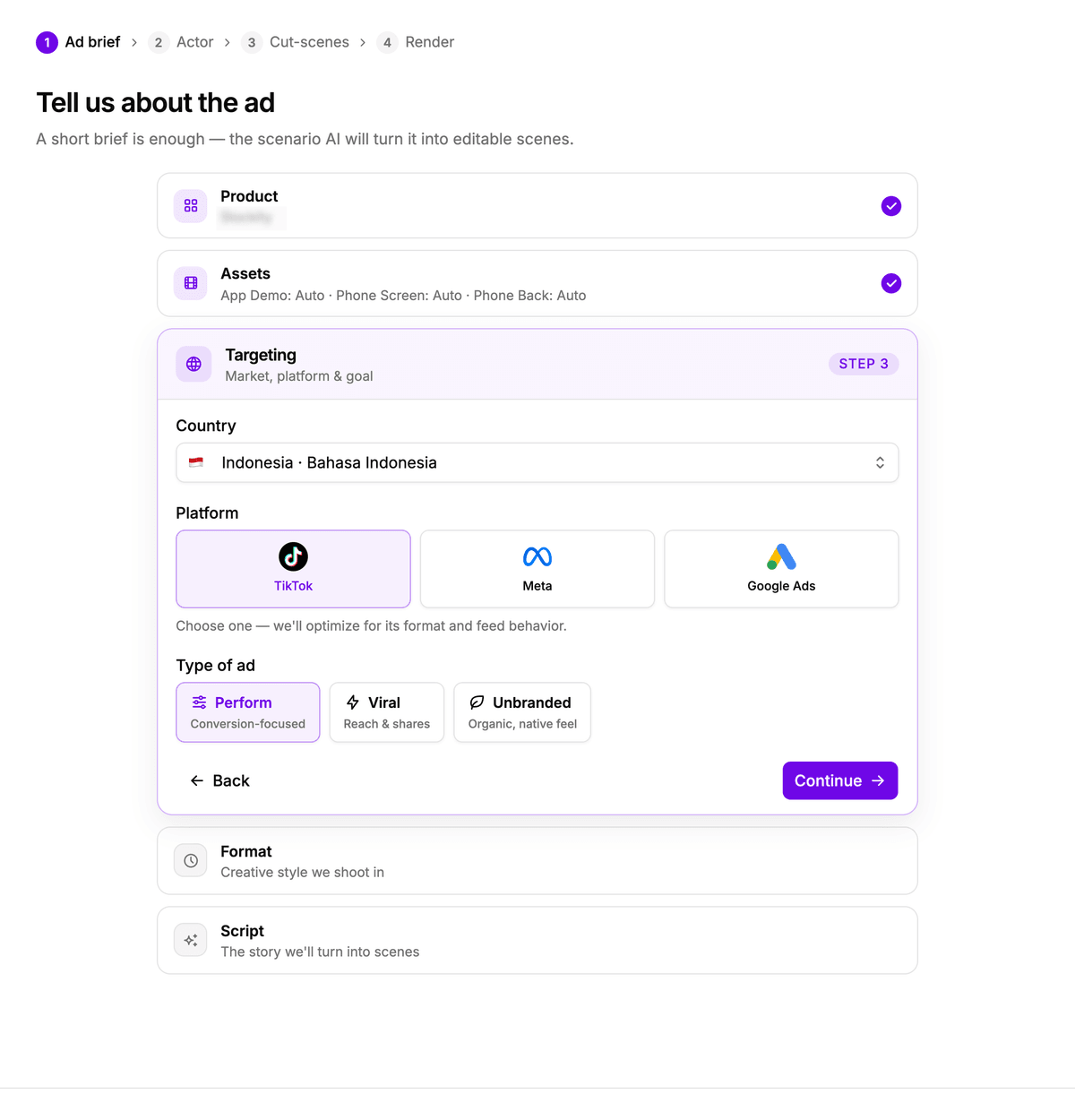
The marketer sets targeting, language, product, and its features straight into the brief, down to some details like "the actor is sitting in a Mercedes." Assets load in once, from demo screens to ending screens and screenshots, and the engine stitches them into the finished video. Picking the platform and ad type applies each platform's rules and the company's internal market policies to the prompts, so every output stays compliant by default.
brief configuration
02 · Scenario
Scene-by-scene scenario builder
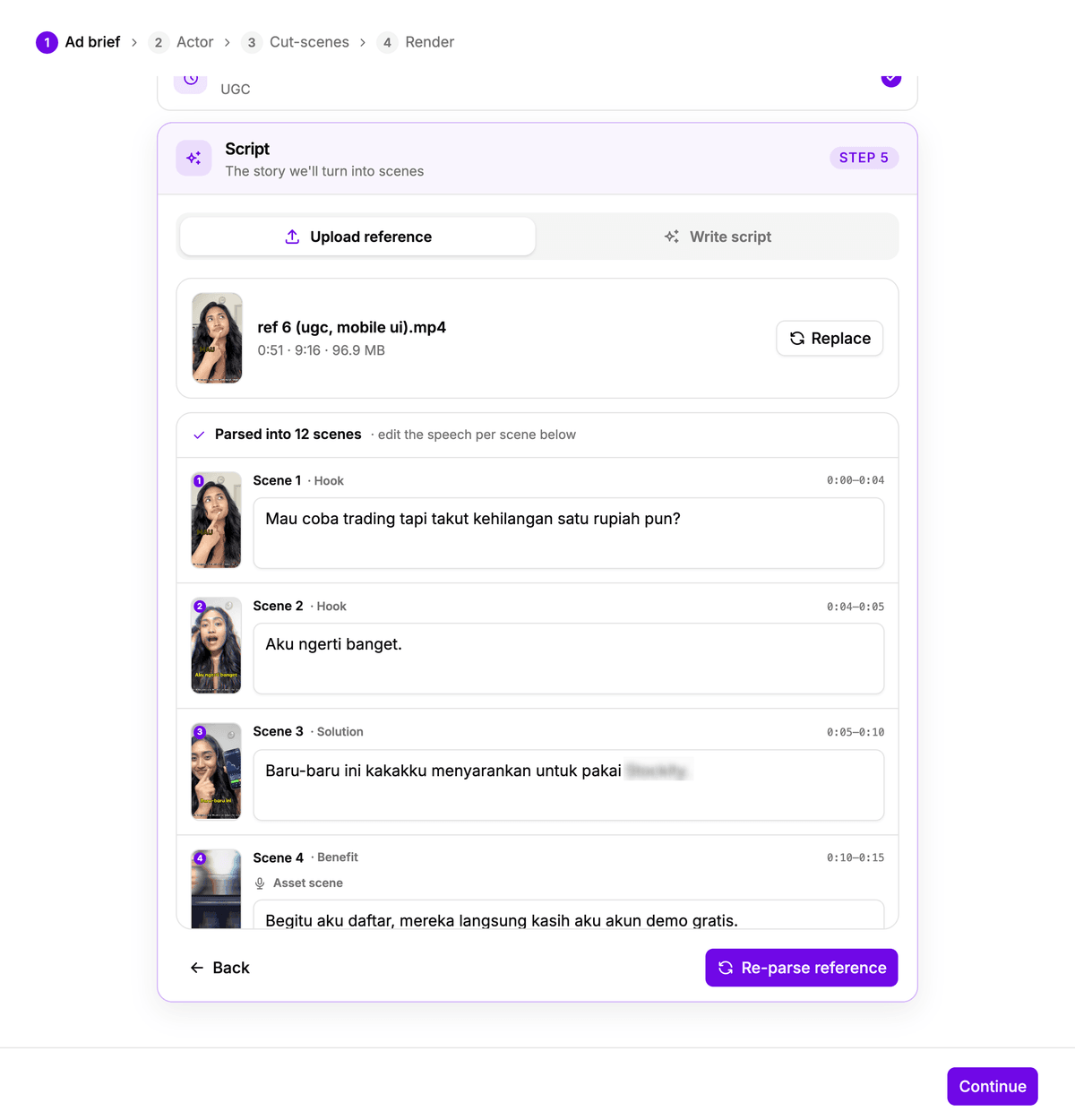
Each ad is written scene by scene, with the format set per scene: UGC to open, an app-demo scene that drops in the client's own asset, then a closing scene that carries the call to download.
scenario builder
03 · Actor
Generated actors and reusable library
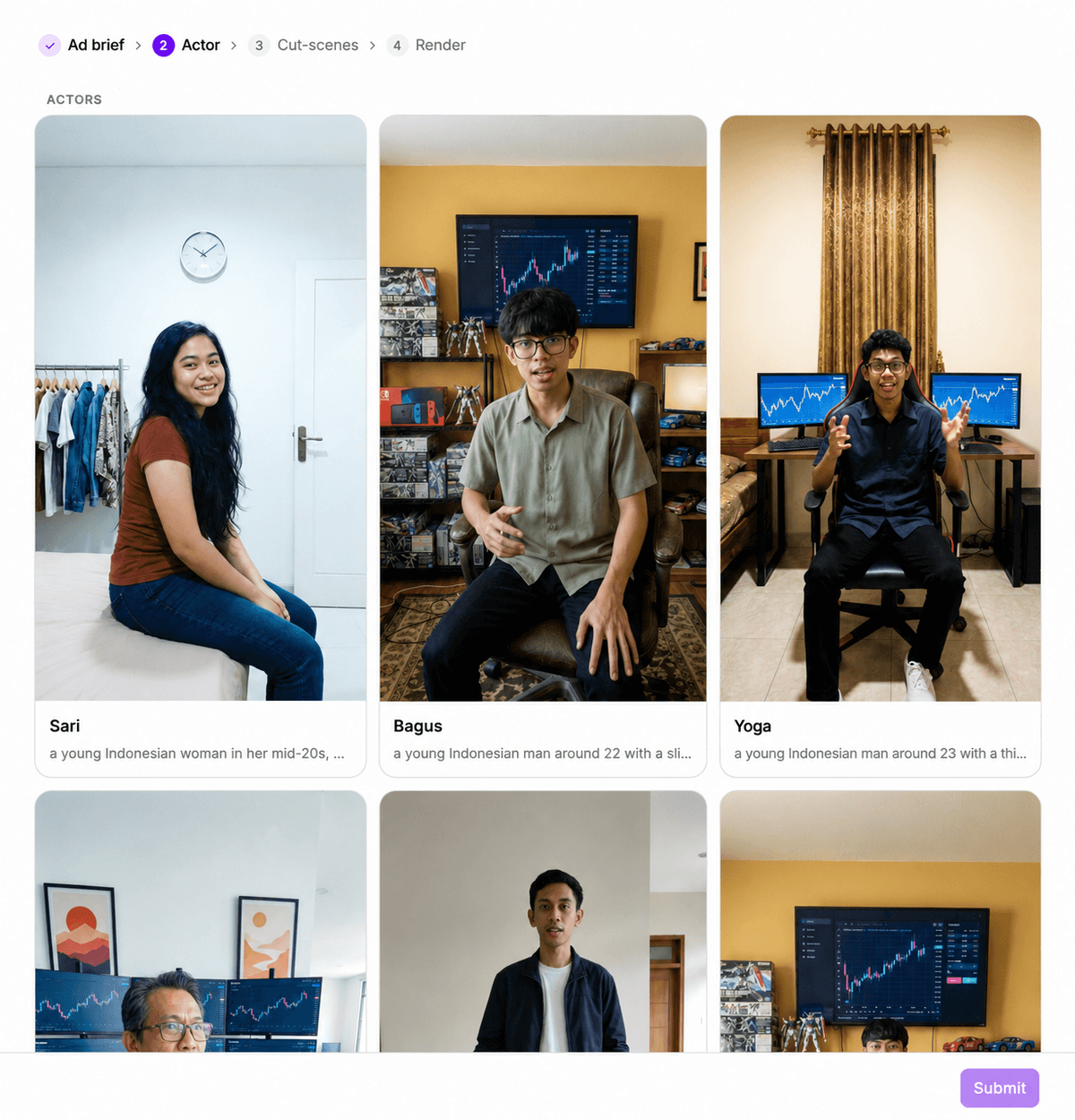
The system generates an actor from a text description,whatever the market calls for, or pulls a ready one from a library we built up. The same actor can be reused across creatives.
actor selection
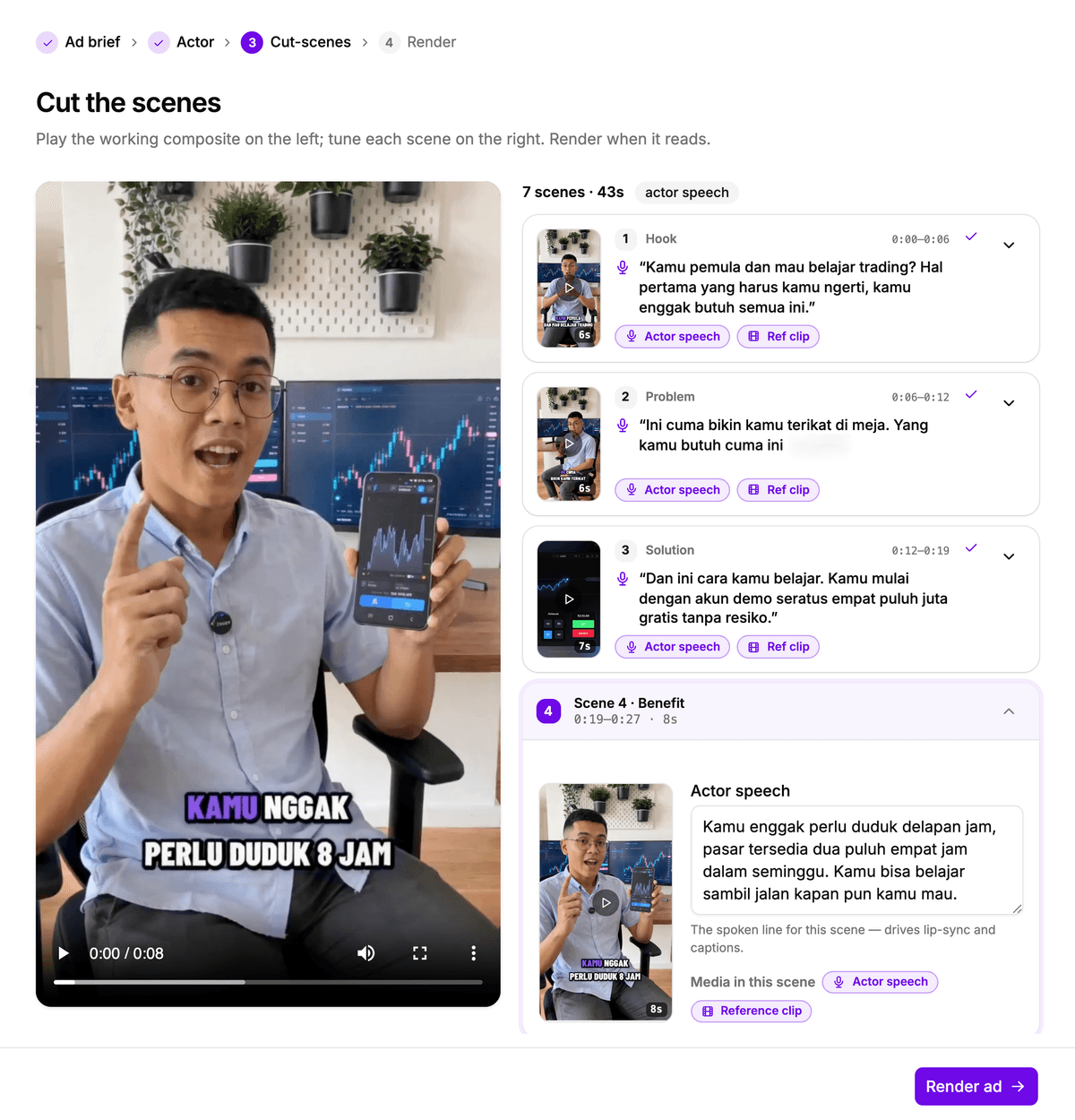
04 · Preview
Preview-first scene validation
The system renders scene previews as still frames first, so the marketer approves the look before anything moves. Animation is the expensive part, so validation happens where it is cheap. Subtitles are generated from the script and rendered straight into the frame without manual timing and separate captioning pass.
scene previews
05 · Consistency
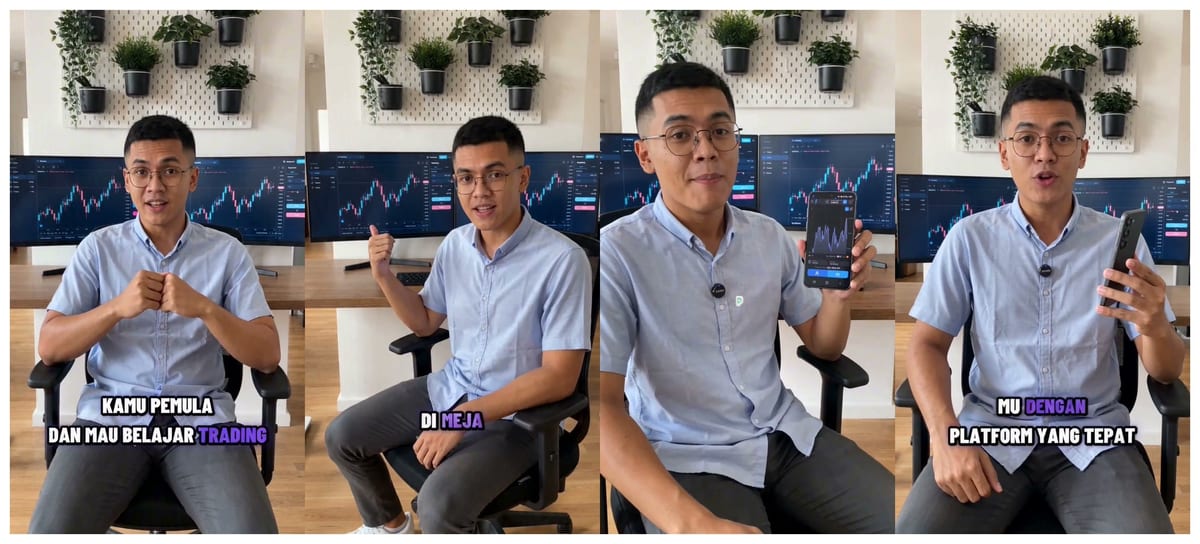
Cross-scene character consistency
Characters and setting hold across a four-scene ad through pre-generated first frames, with each scene built to continue from the last frame of the one before it.
scene consistency
06 · Animation
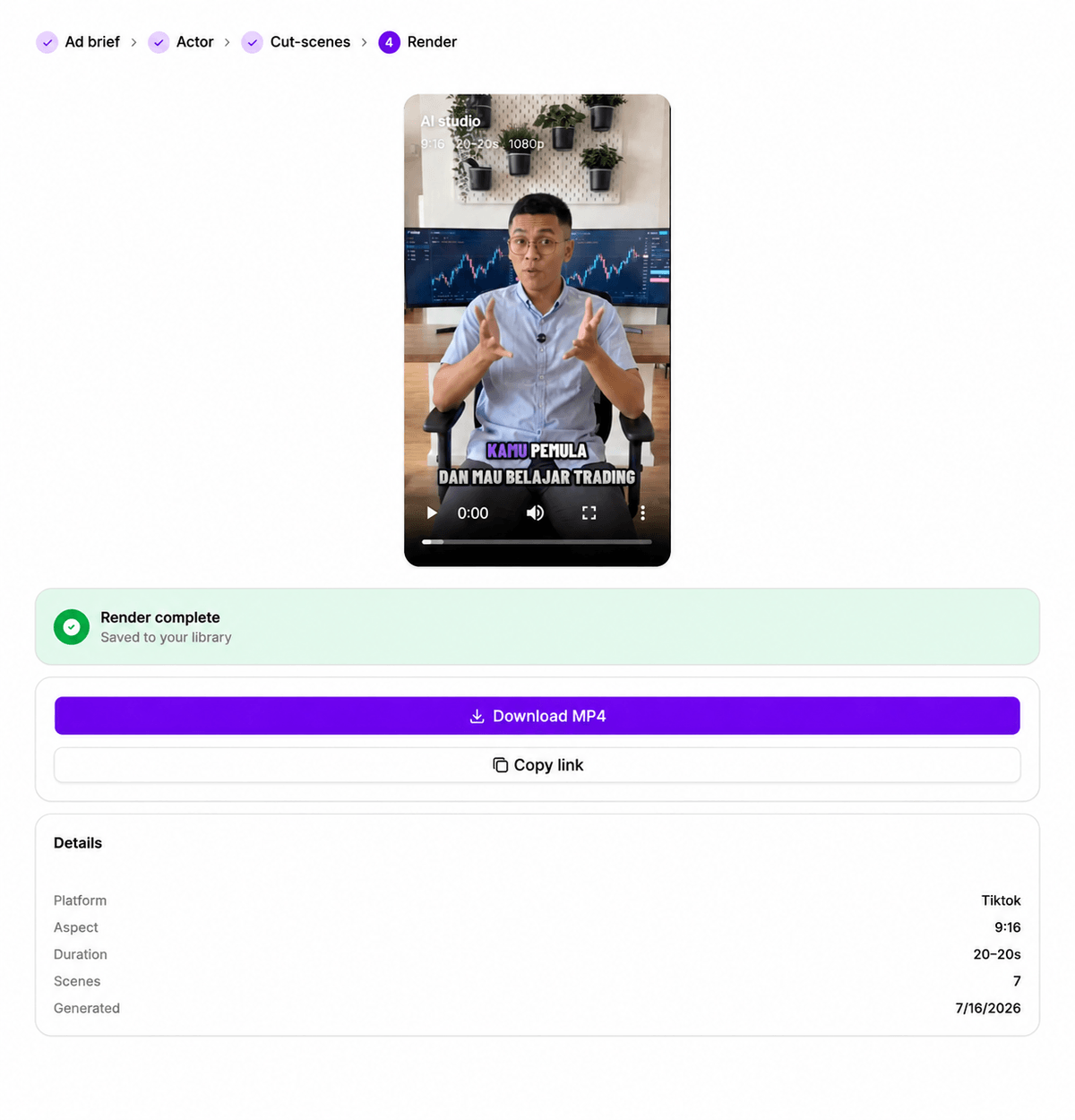
End-to-end video generation
Approved previews get animated into talking, moving scenes. One model chain produces the actor's voice, motion, and environment together. Voice comes from the video model itself, steered by a described tone so the actor sounds consistent across scenes without a separate dubbing pass.
video generation
Results
What the engine produces now
The team now produces finished, policy-compliant UGC reels from a brief, without adding headcount. Compliance is built into every generation, so platform and market rules apply automatically. A quick experiment showed about a third of the market speaks English and reads as the more aspirational register — the kind of answer you only get by running the experiment cheaply, which is exactly what the system is for.

200→on demand
creative volume
~10 sec
to generate three scripts
$4–6
per 30-second videoThe moat
Compliance and craft the competitors lack
Any team can call the same video models. The defensible part sits in what the engine knows about this client — its compliance logic, its winning creatives, and a learning loop that compounds with every campaign.
01
Encoded compliance
Each platform's rules and the company's internal market policies live inside the prompt templates, down to Indonesia's cultural specifics. A competitor with the same models still lacks the client's own compliance logic.
02
Built on the client's real winners
The templates come from the client's actual creatives and asset library, so output matches what already converts for them. The library compounds as the team adds each new template.
03
A learning loop as the next layer
The roadmap feeds campaign performance back into the engine, so creatives adapt to what converts. A research agent, already piloted, scans the market for competitor creatives, trends, and news hooks to feed the templates.
Project details
An ongoing, co-built product
moat8 built the creative engine behind the client's ad studio.
Phase 1 · Live now
A working constructor that proves control over every step of a creative — scenario, actor, preview validation, animation, voice, consistency, and captions, for UGC reels. It runs on prompting, the core of the product: real client use cases turned into policy-compliant templates.
Phase 2 · On the roadmap
Two more creative formats — Life Story, where an actor reaches the product through a real-feeling narrative, and Motion Graphics, the interface-heavy format — plus ready-made scenario templates, a "make something similar" flow for fast variations, and a research agent that pulls the open web into the pipeline, already piloted for the client with a large market-entry report on what works in creatives for a new market and what to avoid.
System components enabled
Brief configurationProduct-driven scriptingAsset stitchingPlatform policy enforcementInternal policy enforcementMulti-script generationActor generationActor libraryScene preview validationIterative animationUGC creative generationAutomatic subtitles
Tech stack
What it runs on
A production stack chosen for cost, photorealism, speed, and control over compliance.
LLM
Claude Opus 4.8
Turns briefs, product details, and policies into scene-by-scene scripts.
Video generation
Veo 3.1Seedance 2.0
Veo and Seedance generate a talking actor directly — voice and motion in one pass — so the pipeline stays lean with the actor's voice, realistic movement, and environment produced end to end.
Image generation
GPT Image 2.0Nano Banana ProNano Banana Pro Edit
Photorealistic actors and backgrounds with character and environment consistency across scenes — the most realistic, detailed, artifact-free model for marketing work. Edit places the same actor into different positions.
Subtitles / captions
veed/subtitles
Automatic captions rendered straight into the video.
Prompting
Langfuse
Prompting is the core of the product. We turned the client's real use cases into templates that respect the company's internal policies and each platform's rules.
Next step