


6 hours→5 min
per individual development planBack
Inclusive education · AI platform
Manual approach to inclusive education rebuilt into an AI agent
Inclusive education worldwide runs on the same manual model with experts writing every learner's plan by hand. That makes support expensive, slow, and available only where the specialists are. UNOWA spent years building an internationally recognized methodology inside that model, and together we turned it into an AI system: an agent that profiles each learner, generates a personal learning plan in minutes, and works in any language. Expert knowledge that used to sit with a limited circle of specialists is now accessible to every specialist, parent, and child. After launch, the platform won the ETIH Innovation Awards 2026 for Best Special Needs and Inclusion Solution.
Per individual learning plan
6 hours→5 min
Industry recognition
ETIH '26Winner
The Problem
Where the old process broke
UNOWA delivers inclusive education programs to governments and institutions across Europe. Its main product, MIKKO, supports children and adults with special educational needs. The methodology behind it is internationally recognized and backed by some of the world's largest development institutions, including the World Bank, USAID, UNDP, and KfW. But producing individual development plans (IDPs) at scale with consistent quality was not possible with the existing process. Each plan was built by hand and took up to six hours: a learner completed an assessment, a specialist interpreted the results, wrote recommendations, and formatted the IDP — with quality that varied from case to case. Learner questions went straight to educators. Every new language market meant fresh translation, reconfiguration, and setup. The team could only grow with demand, because there was no way to scale otherwise.
6 hoursPer individual development plan, by hand
ManualThe methodology lived in specialists' heads
What we built
One platform, an ecosystem of modules
UNOWA's model is based on 3 parts: Spaces, Knowledge, and Innovation. Spaces is the physical side, the environments and the trained specialists, and UNOWA had years of experience building both. We took the other two, Knowledge and Innovation, and rebuilt them as a digital, AI-native platform. Years of accumulated methodology, assessment logic, and domain expertise became a system that produces consistent output without a specialist working manually on every case. The platform is built as an ecosystem of interconnected modules: an orchestrator selects which data sources to pull from — assessment results, specialist notes, course content — and composes the agent's context dynamically rather than loading everything at once.
01 · Workspace
Unified specialist workspace
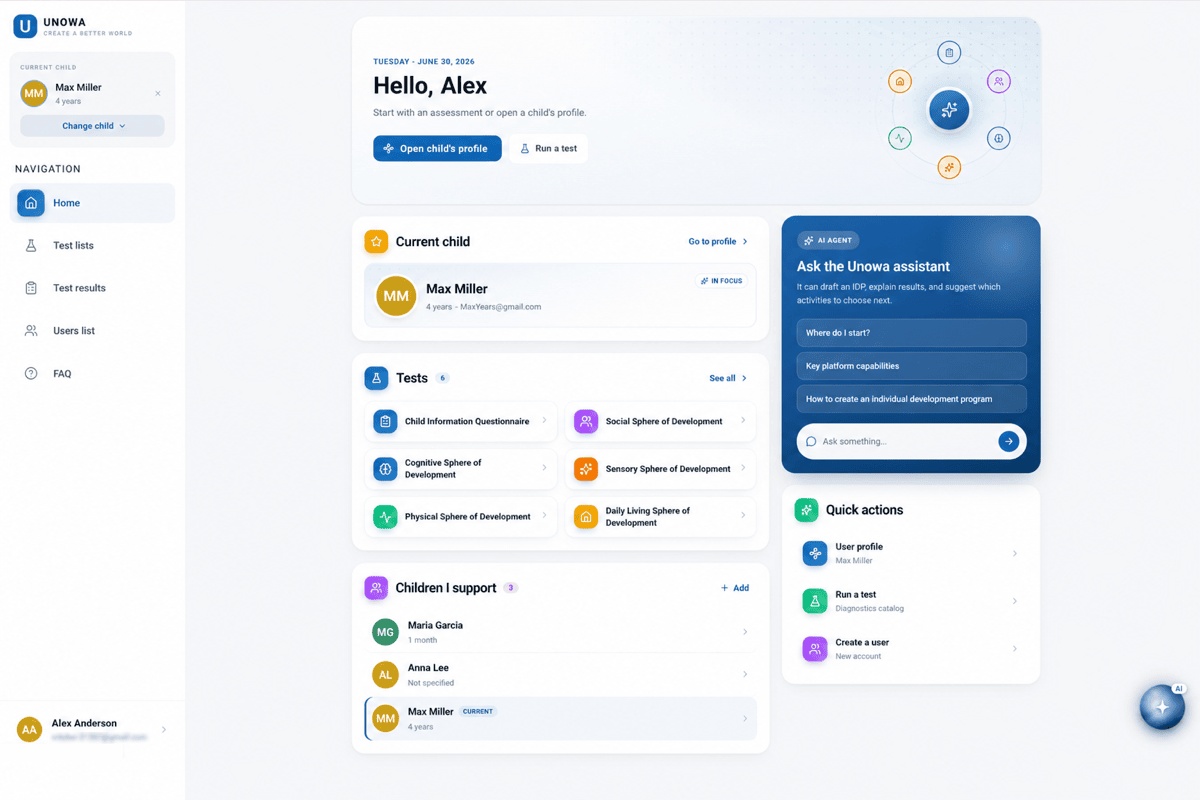
Specialists open the platform to a single home — start an assessment or open a child's profile, move across every developmental domain, and track the children they support. The AI agent sits alongside, ready to draft an IDP, explain results, and suggest which activities to choose next. Every module is one step from here.
home · dashboard
02 · Profiling
System-driven learner profiling
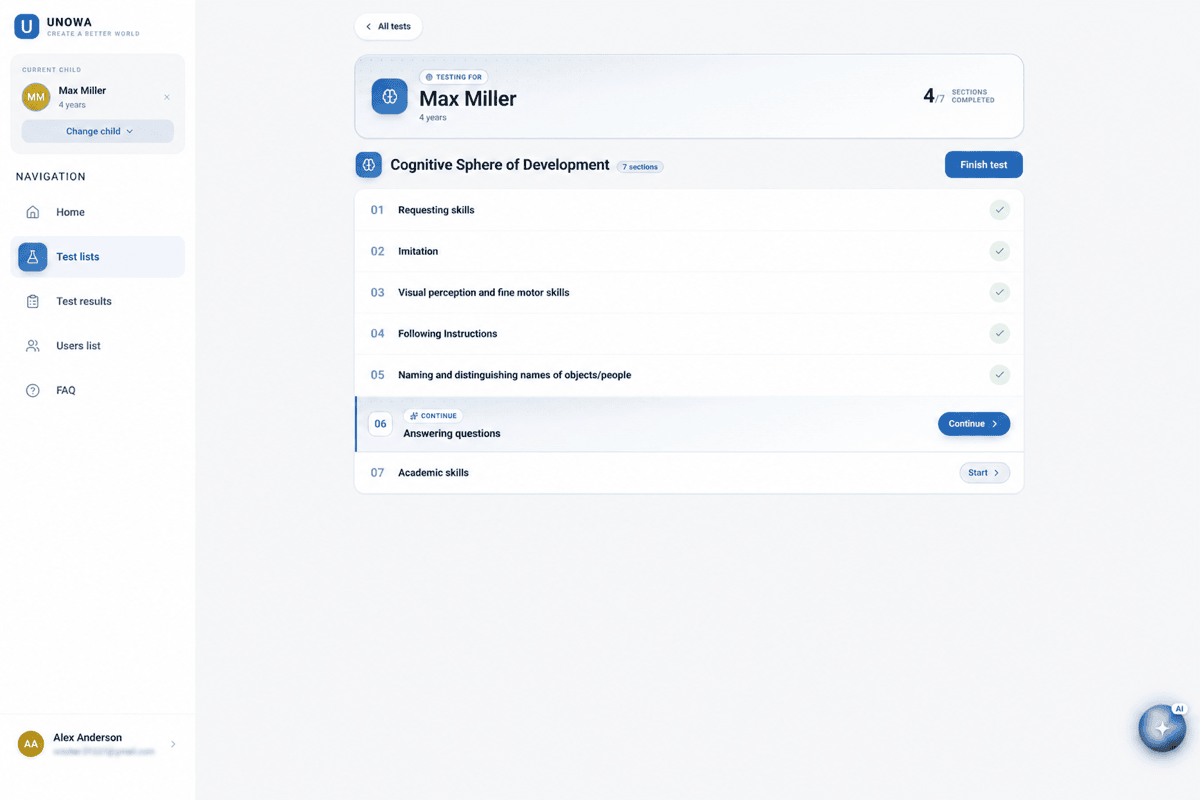
A learner completes an assessment and the platform maps the results to psychological and learning scales and generates a full learner profile, including communication style, content sequence, and example preferences.
cognitive assessment
03 · Generation
Automated development-plan generation
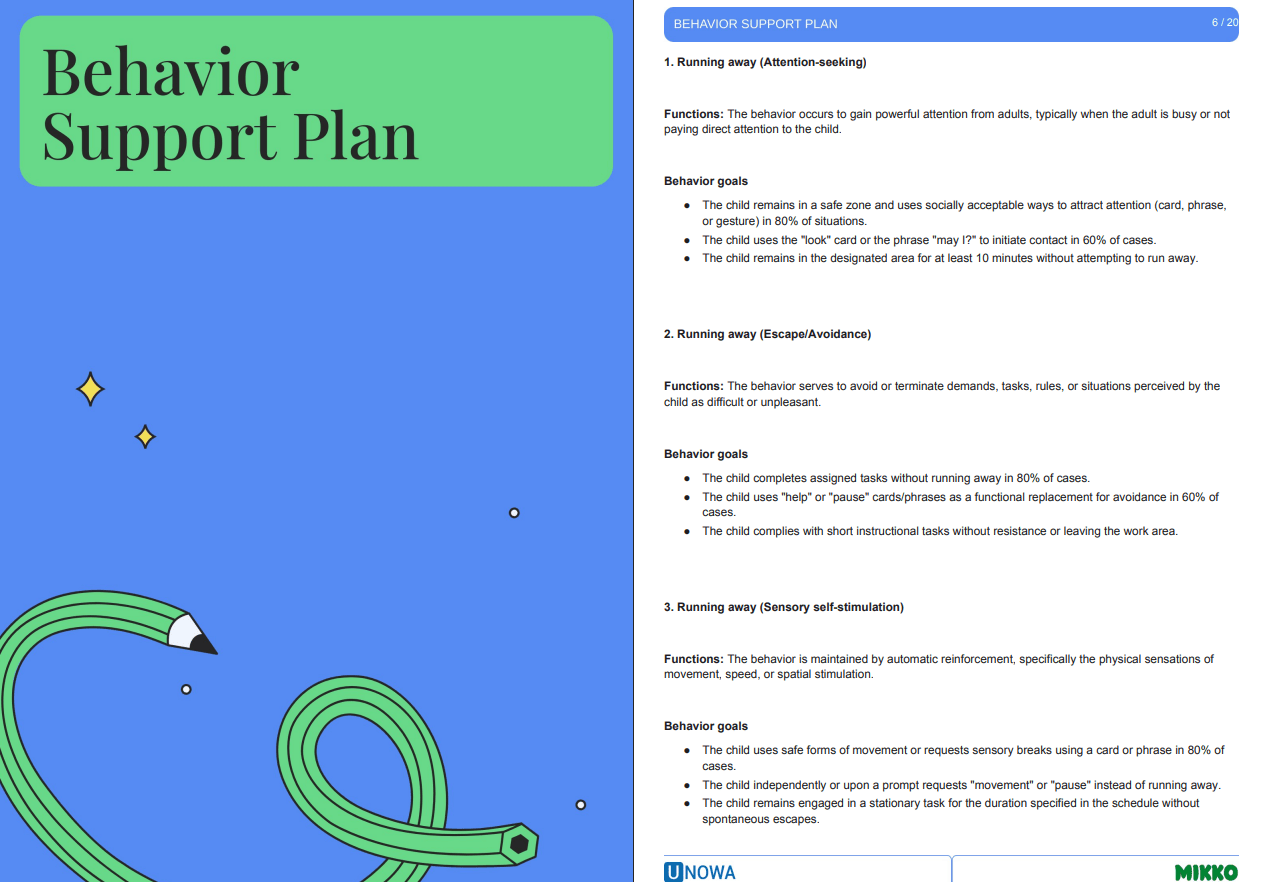
From that profile, the system generates a complete Individual Development Plan with structured recommendations and a consistent format.
development plan
04 · Memory
Persistent per-learner memory
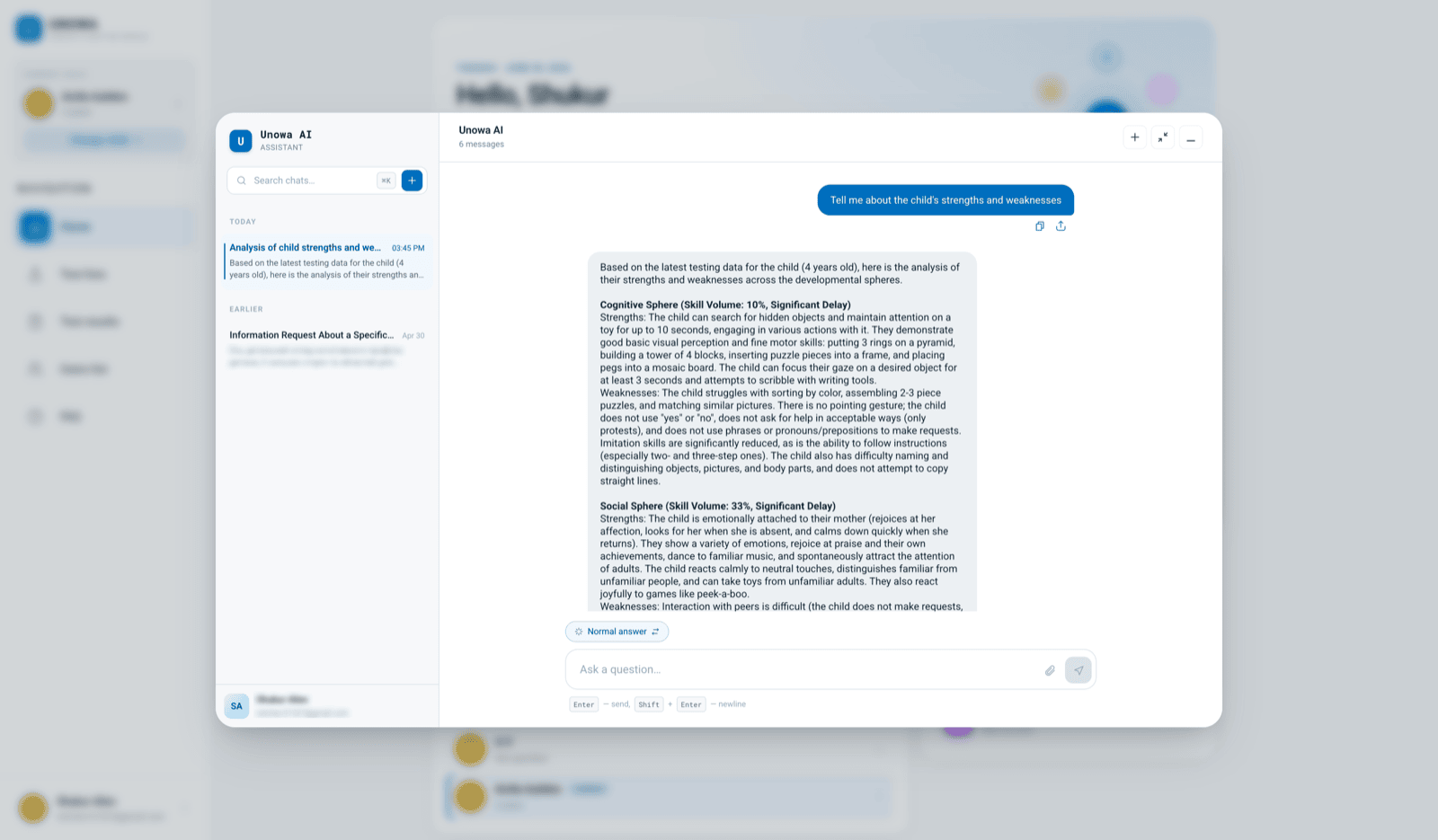
The AI agent is continuously fed data about each learner — from assessments, specialist notes, and session observations — and maintains individual memory per learner, so responses are always personalised to that child's profile.
learner memory
05 · Retrieval
Self-expanding course knowledge base
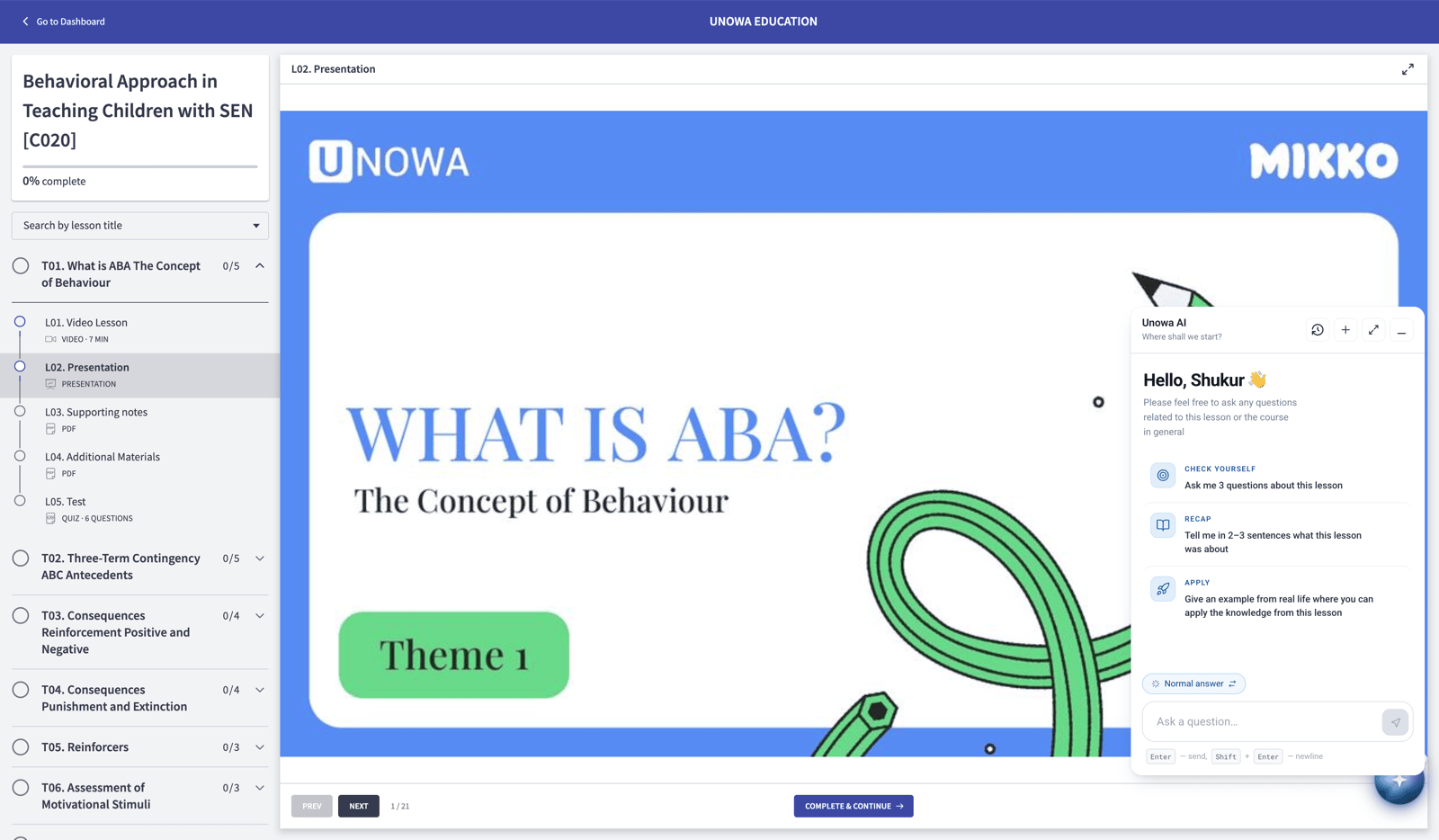
Courses are available directly on the platform. When a specialist purchases a course, it is added to the agent's knowledge base, making the agent more knowledgeable and capable for that specialist's work. The agent also uses the context of the currently open lesson to answer questions in real time.
course assistant
06 · Review
Exception-based specialist review
Specialists review exceptions instead of writing every document from scratch. Junior specialists work independently, guided by the AI, while senior curators oversee at a high level — multiplying throughput without depending on a single expert.
07 · Localization
Configuration-driven multilingual core
Language works as a core platform setting across courses, tests, prompts, and responses, so entering a new market becomes configuration work instead of a rebuild.
08 · Distribution
Parent monitoring and support track
Parents can monitor their child's progress, ask the agent about meltdowns or development steps, and access a parallel psychological support track with their own assessments.
Results
Before and after the platform

Varied→Consistent
quality, no longer tied to the specialist
Rebuild→Config
new markets, added through language settingsThe moat
The methodology, now compounding
The platform runs on UNOWA's own methodology — but it now lives in the heart of the product instead of in the minds of individual specialists. Every learner makes the system sharper, so the moat deepens with use.
01
Each learner improves it
Assessment data strengthens the profiling engine, and IDP outputs test and refine the methodology with every case.
02
A growing knowledge base
New questions to the assistant feed the company's knowledge base, so the platform gets smarter and more accurate over time.
Project details
~12 months to first users
A seven-person team — senior ML, CTO, fullstack, QA, DevOps, business analyst, and project manager.
Phase 1 · Audit & architecture
Methodology audit across every program, content, assessment frameworks, IDP formats — then a unified architecture with shared tooling and separate content logic.
Phase 2 · Engine & assistant
Profiling engine for assessment-to-learner mapping and knowledge-corridor logic, automated IDP generation, and a RAG assistant connected to course content with per-course tone and scope controls.
Phase 3 · Scale & launch
Multilingual infrastructure across every component, any-LMS integration via injected JS bundle, mobile apps for iOS and Android, then production launch and specialist onboarding.
System components enabled
Profiling & knowledge-corridor engineAutomated IDP generationRAG assistant · per-course controlsPer-learner agent memoryMultilingual infrastructureAny-LMS embed · injected JS bundleMobile app · iOS & AndroidWindows desktop · sensor integration
Tech stack
What it runs on
A production stack chosen for compliance, ownership, and regional coverage, with every layer handed over on delivery.
Frontend
React · TypeScriptMantine UIEffectorSASS modules · Vite
Mantine gives a rich, easily customized component library; Effector isolates view from model logic; TypeScript keeps it type-safe.
Backend
Node.js · TypeScriptBullMQ · RedisPostgreSQL · Hasura GraphQLMilvus · Mem0LangGraph · LangChain · LangfuseMinIO · Keycloak
LangGraph orchestrates the agent; Hasura handles RBAC across four roles and multi-tenant scopes; Keycloak is the identity provider; Milvus serves vector search and Mem0 per-learner memory.
AI models
Gemini Flash · conversationalGemini Pro · report generationGemini Embedding · vector search
Gemini throughout for regional compliance — GDPR and local data residency — plus Google Cloud's global coverage for B2G deployments and cost efficiency.
LMS integration
Injected JS bundleThinkific & any platform
An external JS bundle with a clean API embeds the RAG widget into any LMS, with per-learner chat contexts — straightforward to drop into any platform.
Mobile app
React Native · ExpoExpo Router · NativeWindEffector · Reanimatedexpo-secure-store
One codebase for iOS and Android. Expo provides tested native modules, simpler builds, and OTA updates; Reanimated runs animations on the native thread for smooth 60fps.
Sensors desktop app
Qt 5.1 · C++WebView · Socket.IOReact · TS · Effector
The sensor SDK was C++-only. A local socket relay streams sensor data to a WebView UI over WebSocket, with the AI agent embedded alongside.
Next step